
Midvale Park Is Its Own Kind of Neighborhood
Midvale Park isn’t a handful of streets that grew up over time. It’s a master-planned community that started going up in 1982, and it now holds about 3,550 homes between I-19 on the east, Mission Road on the west, Irvington Road on the north, and Valencia Road on the south. Most people around here know the shopping along Valencia at Midvale Park Road. From there, our shop at 227 E Valencia Rd is about 2.5 miles straight east on Valencia. That’s close enough that when you call us for roof leak repair, David can usually be on your roof without anyone fighting traffic across town.
Midvale Park also sits inside Tucson city limits. That matters more than it sounds, because a lot of the neighborhoods just to the west are unincorporated Pima County, and the two have different rules. Tucson Fire Department Station 18 sits on Drexel Road, right next to Grijalva Park.
The rule you’ll actually run into is about permits. The City of Tucson’s permit exemption guide says replacing roofing with the same type of material, like tile for tile, doesn’t need a permit as long as there’s no structural work. But it also says any structural roof work needs one, and it spells out what that includes: replacing sheathing or decking, joists, or trusses. Adding a new roof penetration, like a skylight or a new vent, needs a permit too.
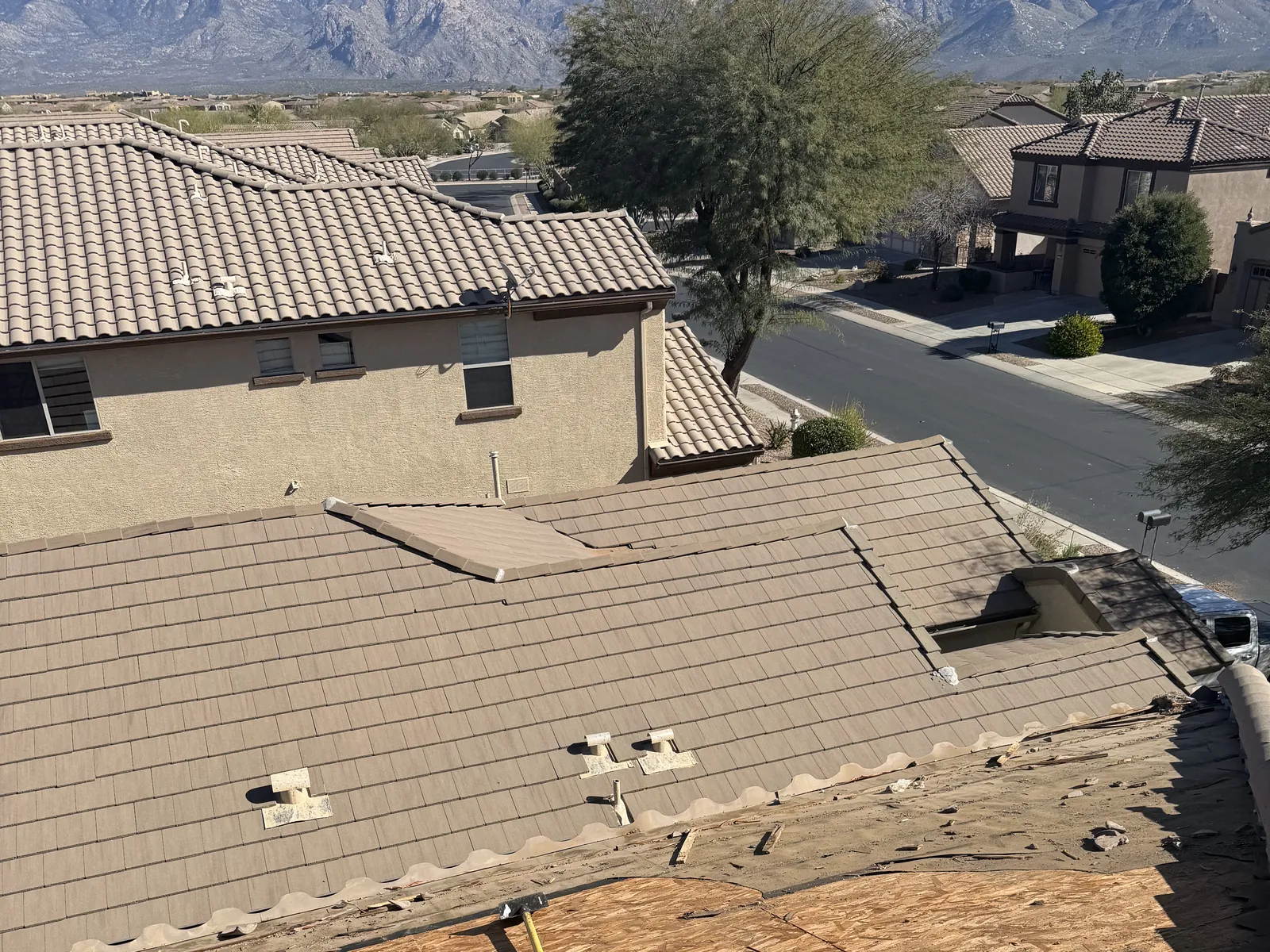
So here’s what that means for a repair. Swapping cracked tiles or replacing underlayment under a tile section stays on the surface. If we lift those tiles and the plywood underneath is soft from a leak that’s been going a while, replacing it is structural work in the City’s eyes. When that happens, we pull the City permit, and you’ll know about it before anything gets torn out, not after.
Built in Waves, From 1981 to 2007
Pima County’s subdivision records show Midvale Park wasn’t built all at once. It filled in over about 25 years, and the age of your roof depends a lot on which phase your house is in:
- The early 1980s: Oak Tree at Midvale Park came first, with its first phase recorded in 1981 and more phases through 1986, close to 1,000 lots in all. The Village at Midvale Park followed in 1983 to 1985.
- 1986: The Greens at Midvale Park (359 lots) and Laurel Heights (221 lots).
- The 1990s: Woodridge (1994), Cambrie at Midvale Park in phases from 1994 to 1999, Gates of Midvale Park (1998), and the first Oakview phase (1999).
- The 2000s: The rest of Oakview and Oakmore (2000), Czarina Heights (2000), Paraiso (2001), Valencia Place (2002), and Sunset Pointe at Midvale Park (2007).
The Census Bureau’s American Community Survey (2020 to 2024) tells the same story. In the tract around Grijalva Park, the median home was built in 1991, about 80% of homes are single-family houses, and roughly three out of four were built in the 1980s or 1990s. A little farther north, around Sarah Ann Miller Park, the median home is from 1995, more than a quarter of the homes are in apartment buildings, and close to half are rented.
Here’s how that plays out on the roof:
- The 1980s phases: These homes are around 40 years old now. If yours still has its original underlayment under the tile, it’s at the age where that layer dries out, cracks, and stops shedding water. The tile on top usually looks fine. That’s what fools people. A leak here is rarely a broken tile. It’s the layer underneath.
- The 1990s phases: At 25 to 30 years, we’re more likely to find early wear than outright failure. Vent pipe boots and flashing around penetrations tend to go first, and catching them now keeps the underlayment around them dry.
- The 2000s phases: Mostly a maintenance conversation. An inspection after a rough monsoon season, a look at the flashing, and a record of what’s been done so you’re not guessing later.
- Two-story homes: If your house is two-story, you can’t see much of the roof from the street, and the spot where a one-story section meets a two-story wall is a common place for water to sneak in. We check that flashing on every inspection.
One more thing about tile in a planned community. If your subdivision has an HOA, check whether it has rules about roof tile color before tiles get replaced. Matching new tile to what’s already on your roof, by color and design, is part of how we handle tile repair, and it’s a lot easier when everybody knows the rules going in. And if you own one of the rentals around here, tell us when you call. You’ll get the inspection photos, so you can see what we saw without climbing up yourself.
Water Moves Through Midvale Park
Midvale Park sits right along the Santa Cruz River. The West Branch of the Santa Cruz runs right past Grijalva Park, the main Santa Cruz River channel runs along the east edge near I-19, and the Oaktree Channel cuts past the shopping area on Valencia. When a July storm parks over this side of town, you can watch those channels fill up.
That same rain is what tests your roof. The National Weather Service’s normal for a Tucson monsoon season is a little over 6 inches, and a lot of it comes in short, heavy bursts. Wind pushes it sideways into the joints that a gentle rain would never reach: the flashing where a lower roof meets a second-story wall, the valleys where two roof planes come together, and the boots around vent pipes.
Then the heat finishes the job. A tile roof in July can hit 160 degrees on the surface in the afternoon and cool off overnight. Year after year of that expansion and contraction is what breaks down underlayment, and it’s why the 1980s homes here are the ones we look at most closely.
If a storm does damage your roof, take photos before anything gets moved or patched. Insurance usually covers sudden damage from wind, hail, or debris, and not slow wear. We document the damage for your adjuster, we don’t work on contingency, and we don’t charge extra for the paperwork.
What a Tile Repair Looks Like Here
David Contreras has been roofing in Tucson since 2011 and started DC Roofing of Arizona in 2020. We’ve completed over 800 roofs, and about 90% of them have been tile, which is a good fit for a neighborhood built mostly with tile roofs. The company holds Arizona ROC license #328733 and is bonded and insured, with $1M per occurrence and $2M aggregate in general liability coverage. David is on every job, and the crew is his own. No subcontractors.
On a typical Midvale Park tile repair, this is what happens:
- David gets on the roof. The inspection is free and takes about 45 minutes on most homes. He checks the tile, the underlayment, every penetration, and the flashing at walls and valleys, and documents it with photos.
- You get the honest version. If a repair will hold, that’s the recommendation. If the underlayment is failing across most of the roof, you’ll hear that too, with photos to back it up. You get a written estimate with line-item pricing.
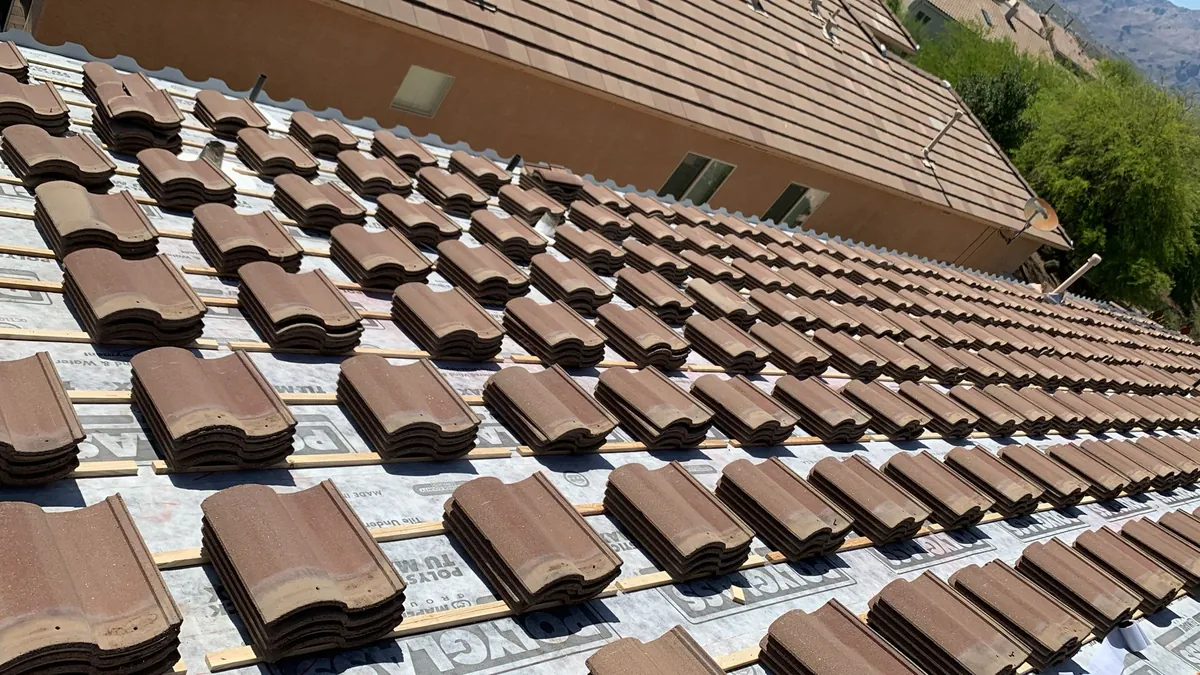
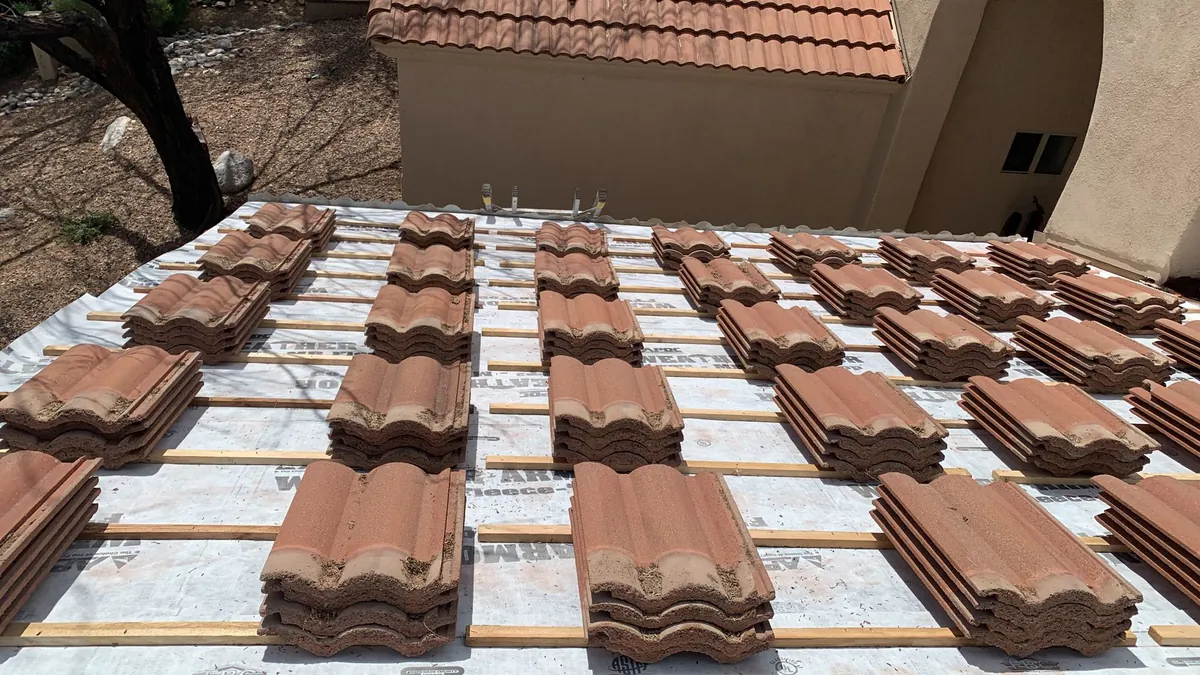
- The tile comes up, the underlayment goes down. Tiles around the problem area are lifted and set aside, failed underlayment and any bad decking get replaced, and the tiles go back down, with matched replacements for any that are broken.
- It’s usually a one-day job. Most standard tile repairs are done in a day. Summer work starts early to beat the heat.
- Cleanup and a check. Debris is cleared, the yard gets a magnet sweep for nails, and the repair is verified, with a water test if needed.
Our repair contracts include up to 5 sheets of decking at no extra charge, and repairs carry a 2-year labor warranty. Interior drywall and ceiling repair aren’t included, since that’s a separate trade. And because Midvale Park is inside city limits, remember the permit rule: if your repair turns into decking replacement, we tell you upfront and pull the City permit ourselves.
On cost, nobody can give you an honest number without getting on the roof. As a general range, minor repairs like flashing or a few tiles typically run $300 to $800, and repairs that involve replacing underlayment under a larger tile section typically run $1,500 to $4,000. A leak caught early is almost always the cheaper one.
If you’re seeing a ceiling stain or a slipped tile, or you just bought a 1980s house in Oak Tree and want to know what you’re working with, call (520) 979-9095. We’re about 10 minutes down Valencia.