Expert Roof Repair for Tucson & Southern Arizona
David Contreras, owner of DC Roofing of Arizona, has been repairing roofs in Tucson since 2011 - long enough to know exactly where this climate puts your roof under pressure and what a real fix looks like. As a locally owned roofing contractor, DC Roofing of Arizona (ROC #328733) was founded in 2020 and has completed over 800 roofs across Tucson, Oro Valley, Marana, and Southern Arizona. If you're seeing a stain on your ceiling or a cracked tile from the driveway, here's what you need to know.
Watch: DC Roofing of Arizona in Action
Signs Your Tucson Roof Needs Repair Before It Gets Worse
Most people don't look at their roof until something goes wrong inside the house - a water stain on the ceiling, a drip in the hallway during a monsoon. By that point, the damage has been building for weeks or months. The fix is almost always bigger than it needed to be.
Your roof usually gives you warning signs first. Cracked or slipped clay and concrete tiles - the dominant roof type in Tucson - let water straight through to the underlayment with just one break. Dark streaks or stains on your ceiling mean moisture is getting in somewhere, and it won't fix itself. Flashing pulling away from walls or vents is one of the most common leak sources we see: Tucson's heat expands and contracts metal flashing year-round, gaps form, and water follows. And soft or spongy spots when you walk on the roof mean decking damage underneath.
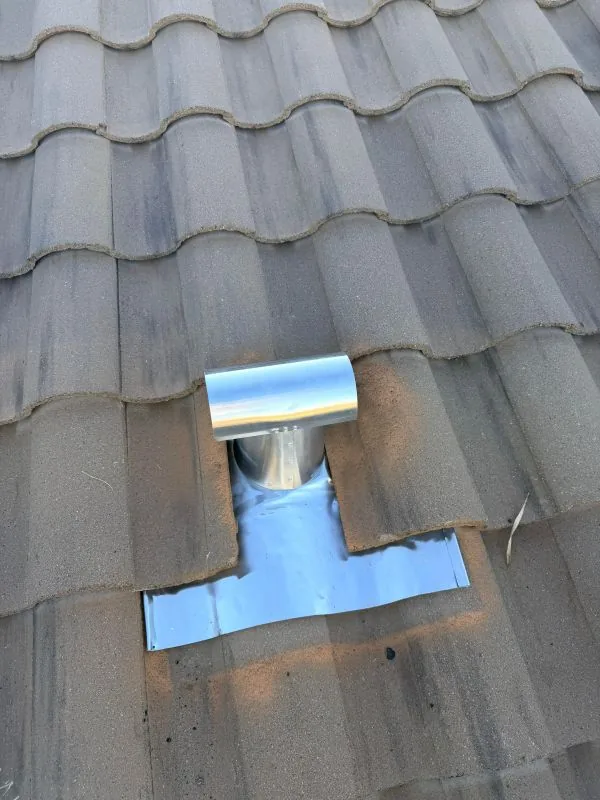
One we see constantly in Sam Hughes and Midvale Park: older homes with evaporative coolers mounted on the roof. The boot seals around those cooler penetrations dry out and crack in our sun - that's where the leak is coming from. A professional roof inspection gets someone up there with a camera so you know exactly what you're dealing with before spending money on the wrong fix.
Flat Roofs, Tile Roofs, and Foam Roofs Need Different Repairs
Not all roofs break the same way, and they don't get fixed the same way. The approach we take on a flat roof near South Tucson is completely different from what we'd do on a clay tile roof in the Catalina Foothills. Treating every roof the same is how repairs fail six months later.
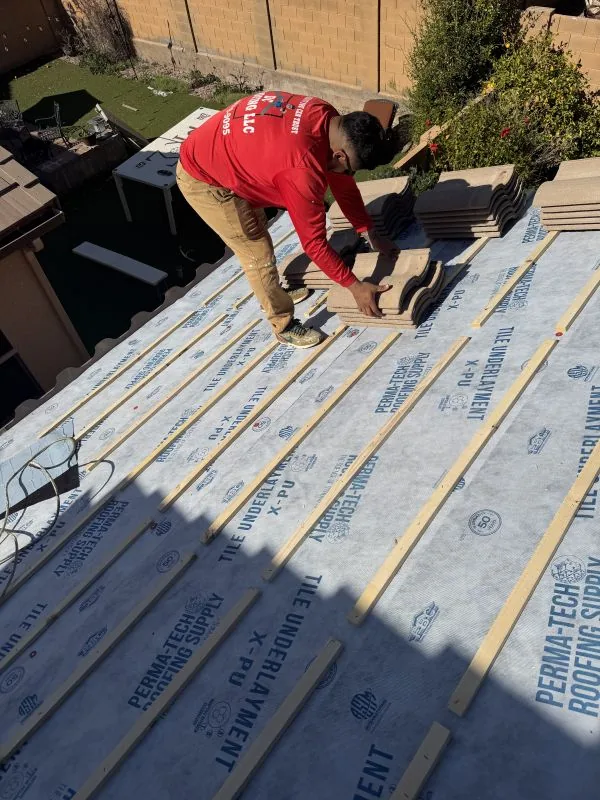
Flat roofs collect standing water - that's their biggest enemy. We see ponding on older flat roofs all over Tucson, especially on commercial buildings and mid-century homes in neighborhoods like Barrio Viejo and Armory Park. Flat roof repair means patching the membrane, resealing seams, or applying a roof coating to restore the waterproof barrier. Tile roofs are everywhere here. Clay and concrete tile hold up well against the sun, but individual tiles crack from thermal cycling or get knocked loose during monsoon winds. The tile itself is rarely the real problem - it's the underlayment beneath the tiles that's deteriorated. We pull the damaged tiles, inspect what's underneath, replace the underlayment if needed, then reset or swap out the tiles. Foam roofs need their own approach. The protective elastomeric coating on top breaks down over time from our UV. Once it wears thin, the foam starts absorbing moisture. Repair means cleaning the surface, removing damaged foam, and recoating before it spreads.
David Contreras grew up working on Tucson roofs, so our crew knows what each material does in this heat. Licensed under ROC #328733, we tell you what your roof actually needs. If a simple patch holds, that's what we recommend. If the damage runs deeper and you're looking at a full roof replacement, we'll tell you that too.
How Roof Repair Works: From Your Call to Cleanup
You've spotted the problem. Maybe it's a water stain on the ceiling or a cracked tile you noticed from the driveway. Here's exactly how a roof repair goes when you call us in Tucson.
David or someone on our team picks up - no subcontracted sales reps. We come out and inspect the roof ourselves: underlayment, flashing around penetrations like evaporative coolers, everything documented with photos. We sit down with you and show you what we found. If it's a repair, we say repair. If the damage runs deeper, we'll tell you that too - no pressure to go bigger than you need. Our crews arrive with the right materials already loaded. For most standard repairs on tile or flat roofs, we're talking one day, sometimes less. Homeowners over in Sam Hughes have told us the cleanup is the thing they notice most: every nail, every scrap of old sealant, every piece of debris cleared before we leave.
Before we pack up, we check the work from above and below - water test if needed. Then we walk you through what was done so you know exactly what's on your roof now. The whole process is simple on purpose. We've done over 800 roofs this way, and it works because nobody gets surprised.
Monsoon Readiness and Preventing the Next Repair
Most roof repair calls we get in Tucson could've been avoided. From October through May, relentless UV exposure and temperatures hitting 160°F on a tile surface break down sealants around pipe boots, crack underlayment beneath tiles, and dry out flashing joints until they pull apart. Then June rolls in, the monsoons hit, and every weak spot turns into a leak path. We see this pattern every year, especially on older homes around the Catalina Foothills and midtown Tucson where roofs have been baking for decades.
The best time to schedule a pre-monsoon inspection is late April or May - before the first storm of the season. Post-monsoon inspections in October are equally valuable for catching what the storms left behind. If a storm has already caused damage, don't wait: water infiltration spreads quickly through insulation and decking, and in Tucson homes with Saltillo tile floors, water that reaches the subfloor causes expensive secondary damage. Our storm damage roof repair starts with a full inspection and photos of everything the storm touched. For active leaks or missing roofing material after a storm, our emergency roofing service provides fast response throughout Southern Arizona.
In most cases, routine roof repairs in Tucson and Pima County do not require a permit. Larger projects involving structural decking or changes to the roofing system type may require a permit through the City of Tucson Development Services or Pima County - DC Roofing of Arizona (ROC #328733) handles permitting on your behalf when required. We offer free annual inspections with every project we complete: catching a cracked tile in April saves you from calling in a panic during a July downpour.

David Contreras, Owner & Founder - DC Roofing of Arizona · Licensed ROC #328733 · Tucson native since 1989
Roof Repair Projects Completed in Tucson
How Our Roof Repair Process Works
- 1
Call or Text - We Actually Answer
David or someone on our team picks up. We'll ask a few quick questions about what you're seeing and get a time on the books, usually within a day or two. No call center, no callback queue.
- 2
We Inspect the Roof Ourselves
No subcontracted sales reps. We get up on the roof, check the underlayment, look at flashing around all penetrations including evaporative coolers, and document everything with photos.
- 3
Honest Diagnosis
We sit down with you and show you what we found. If it's a repair, we say repair. If the damage runs deeper - cracked decking, widespread underlayment failure - we'll tell you that too. No guessing, no pressure to go bigger than you need.
- 4
Schedule the Work and Show Up on Time
Our crews arrive with the right materials already loaded. For most standard repairs on tile or flat roofs, we're talking one day, sometimes less. We schedule early-morning start times in summer so heat doesn't affect material performance.
- 5
Cleanup Before We Leave
Every nail, every scrap of old sealant, every piece of debris cleared from your property. We run magnets across the yard. Your home looks the same as when we got there - or better.
- 6
We Verify the Repair Holds
Before we pack up, we check the work from above and below - water test if needed. Then we walk you through what was done so you know exactly what's on your roof now and what to watch for going forward.
Ready to Get Started?
Fast response. Licensed ROC #328733. 4.9★ across 100+ Google reviews.
Roof Repair Services We Provide in Tucson and Southern Arizona
What Tucson Homeowners Gain from Choosing DC Roofing of Arizona
Roof Repair in Tucson, Oro Valley, Marana, Sahuarita, Green Valley, and Vail
DC Roofing of Arizona provides roof repair services throughout Southern Arizona, including:
Frequently Asked Questions About Roof Repair in Tucson
How do I know if my roof leak is a quick fix or a bigger problem?
A small stain on your ceiling can mean anything from a cracked tile to failed underlayment that's been wet for months. The only way to know for sure is to get someone up on the roof with a camera. We see this constantly in Tucson - what looks like a minor drip turns out to be a boot seal on an evaporative cooler that's been leaking since last monsoon season. A real inspection tells you exactly what you're dealing with before you spend money on the wrong fix.
What's the most common roof repair issue on older Tucson homes?
The most common leak we find on older Tucson homes is a failed boot seal around rooftop evaporative cooler penetrations. The intense sun dries out the rubber seal, it cracks, and the first monsoon storm sends water straight into your ceiling. We run into this weekly in neighborhoods like Sam Hughes and Midvale Park. If you have an evaporative cooler on your roof and you're seeing ceiling stains, that's the first place we check.
Does Tucson's climate affect how roof repairs are done?
Yes, Tucson's heat and monsoon cycle change how repairs need to be done. Thermal cycling - the daily expansion and contraction from extreme heat - cracks tile, pulls flashing away from walls, and dries out sealant joints faster than in cooler climates. Foam roofs need their elastomeric coating refreshed more often here because UV breaks it down quickly. Any repair done in Tucson has to account for what the desert will keep doing to that material after the job is finished.
Can you repair a flat roof the same way you'd fix a tile roof?
No - flat roofs and tile roofs fail in completely different ways and need different repairs. A flat roof's biggest enemy is standing water that sits on a cracked membrane. A tile roof usually fails at the underlayment beneath the tiles, not the tile itself. Using the wrong approach means the repair fails in a few months. We work on flat, tile, and foam roofs regularly across Tucson, so we match the repair method to the actual material.
How long can I wait to fix a roof leak before it gets worse?
You shouldn't wait. Water spreads fast once it gets past the surface layer. In Tucson, a small leak that starts in June can soak your decking and insulation before the monsoon season is over in September. What might have been a simple patch in early summer can turn into a decking replacement by fall. The longer moisture sits in your roof system, the more it spreads - and the more expensive the repair becomes.
How much does roof repair cost in Tucson, AZ?
Roof repair costs in Tucson typically range from $300–$800 for minor repairs (flashing, a few shingles, small leaks) to $1,500–$4,000 for more extensive work involving underlayment, larger tile sections, or structural decking. The wide range reflects how differently roofs fail - a single cracked tile costs far less to fix than a failed membrane section on a flat roof. DC Roofing of Arizona provides free, written estimates so you know exactly what you're paying before any work begins. Call (520) 979-9095.
How much does it cost to fix a leaky roof?
The cost to fix a leaky roof in Tucson depends almost entirely on where the leak is coming from and how long it's been leaking. A fresh leak caught early - a failed boot seal, cracked flashing, or a few broken tiles - typically runs $300–$600. A leak that's been active through one or two monsoon seasons has usually soaked the underlayment and decking beneath it, which pushes costs to $1,200–$3,500 or more depending on how far the water spread. The leak itself is often the cheap part; the hidden moisture damage underneath it is what drives the bill up. That's why we recommend calling as soon as you notice a ceiling stain - even a small one. The longer a leaky roof goes unaddressed in Tucson's climate, the more expensive it becomes to repair.
What factors affect how much a roof repair costs?
Several things determine the final cost of a roof repair in Arizona. Roof type matters significantly - foam, flat membrane, tile, and shingle roofs use different materials and techniques. Extent of damage is the biggest variable: a cracked tile is a quick fix, while failed underlayment under a large tile section requires removing tiles, replacing the membrane, then reinstalling everything. How long the leak has been active matters too - a fresh leak is almost always cheaper to address than one that's been quietly soaking the decking for a season. Height, pitch, and roof accessibility affect labor time. And location on the roof plays a role - a repair near an edge or penetration (chimney, skylight, HVAC unit) is more involved than open field work. We price every job after a physical inspection, not over the phone.
Does homeowner's insurance cover roof repair in Arizona?
Arizona homeowner's insurance typically covers sudden storm damage - wind, hail, falling debris - but not gradual wear and tear or maintenance-related issues. After a monsoon event, document visible damage with photos before any repairs are made, then contact your insurer to file a claim. DC Roofing of Arizona is experienced working with insurance adjusters and can provide detailed documentation of damage to support your claim. We do not work on contingency or charge separate fees for insurance-related documentation.