
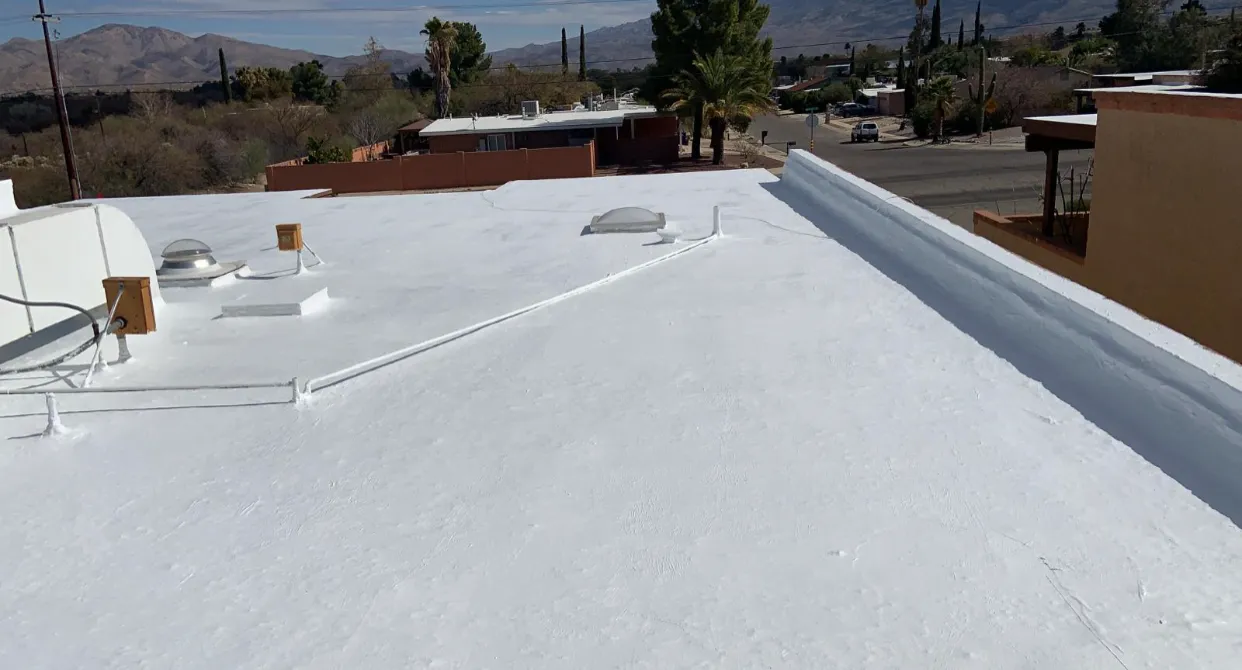
If you have a flat or low-slope roof in Tucson, white elastomeric roof coating is one of the most practical investments you can make in your home. It’s not glamorous, and it doesn’t get talked about as much as tile replacement or new foam roofs — but for the right roof, a quality coating job delivers real, measurable results.
Here’s what it actually does, what it doesn’t do, and what you should know before scheduling one.
What Elastomeric Roof Coating Is
Elastomeric roof coating is a thick, flexible, water-based coating applied directly to a roof surface. The most common type used in Arizona is white or light-colored — either a straight elastomeric (acrylic-based) coating or a silicone-based formula. It goes on like a very thick paint, typically rolled or sprayed, and dries to a rubbery, seamless membrane.
The “elastomeric” part refers to its elasticity — it can stretch and recover without cracking, which matters in a climate where surfaces expand and contract dramatically between day and night. A coating that couldn’t flex would crack under Arizona’s thermal cycling within a season or two.
Most elastomeric coatings are applied at 1.5 to 3 gallons per 100 square feet, building up a film thickness that provides both waterproofing and reflectivity. High-quality products — Gaco, Ames, Henry, and similar brands — carry energy star ratings and meaningful warranties when applied correctly.
The Energy Efficiency Argument Is Real in Arizona
In a mild climate, roof color doesn’t matter much. In Arizona, it matters a lot.
A standard flat roof in Tucson — dark membrane, gravel surface, or aged foam — can reach surface temperatures of 150–190°F on a summer afternoon. At those temperatures, heat radiates downward into the building, your air conditioning works harder, and your energy bills reflect it.
A properly applied white elastomeric coating reflects 80–90% of solar radiation. Surface temperatures on a coated roof drop to 100–120°F under the same conditions — a reduction of 50–70°F on the surface. That difference translates directly into less heat entering the building, less demand on your HVAC system, and lower cooling costs.
Studies by the Department of Energy and Lawrence Berkeley National Laboratory have consistently shown that white or reflective roofs reduce cooling energy use by 10–30% in hot climates. In Tucson, where air conditioning runs for six to eight months of the year, the cumulative savings are meaningful.
For a single-family home with a flat or low-slope roof, the energy savings alone can offset a significant portion of the coating cost over a 5–10 year recoat cycle.
Protecting a Foam Roof Is Not Optional
For homes with spray polyurethane foam (SPF) roofing, elastomeric coating isn’t just a nice-to-have — it’s what keeps the foam from failing.
SPF is installed as liquid foam that expands and hardens on the roof surface. It creates an incredibly effective, seamless, air-tight insulated roof — but it has a critical vulnerability: UV light. Unprotected polyurethane foam begins to oxidize within weeks of exposure. The surface yellows, becomes rough and chalky, and eventually erodes. Once the foam itself starts breaking down, moisture can enter, the foam loses its insulating value, and you’re headed toward a full roof replacement.
Elastomeric coating is what protects the foam from UV. As long as the coating is maintained — typically reapplied every 5–10 years depending on the product and application thickness — the foam beneath it stays sound and can last indefinitely. This is the fundamental maintenance cycle for any SPF roof.
Skipping a recoat because the roof “still looks okay” is how foam roofs fail prematurely. By the time degradation is visible to the homeowner, the process has often been underway for years. A recoat at the right time preserves the entire roofing system. Waiting too long means repairing or removing compromised foam before any new coating can be applied — significantly higher cost.
What Coating Doesn’t Do
It’s worth being clear about the limitations.
Coating is not a substitute for structural repairs. If a flat roof has soft spots, compromised seams, standing water that has saturated the substrate, or active leaks through the deck, those problems need to be addressed before coating. Coating over a compromised surface seals in moisture and delays — but doesn’t fix — the underlying problem.
Coating is not for tile roofs. Tile roofs function differently and don’t benefit from a surface coating. This post is specifically about flat, foam, and low-slope roofs.
Coating doesn’t eliminate the need for maintenance. A freshly coated roof still needs to have its drains and scuppers kept clear, its flashings checked periodically, and any debris removed after monsoons. Coating makes the roof more resilient but doesn’t make it self-maintaining.
Not all coating applications are equal. Product quality matters, but application matters more. Coating applied too thin doesn’t provide adequate waterproofing or reflectivity and won’t last as long as the product’s rating suggests. The surface needs to be clean and dry before coating, existing cracks and seams need to be addressed, and application rates need to meet manufacturer specs. A cut-rate coating job that was applied too thin will start failing in 2–3 years.
What the Process Looks Like
A professional elastomeric coating application typically follows these steps:
-
Inspection and repair — The existing roof surface is examined for cracks, soft spots, failed seams, and compromised flashings. These are repaired before coating. Coating over damaged areas doesn’t fix them.
-
Cleaning — The surface is cleaned, typically with a pressure wash, to remove dirt, oxidation, and anything that would compromise adhesion. The roof needs to be fully dry before coating.
-
Primer (if needed) — Some surfaces benefit from a primer coat, particularly if the existing coating is heavily oxidized or the substrate is porous.
-
Base coat — The first heavy application of elastomeric coating goes on, with seams and transitions getting reinforced with mesh fabric embedded in the wet coating.
-
Top coat — A second application builds film thickness and provides the final surface.
The whole process on a typical residential flat roof takes one to three days depending on surface area and conditions.
How Often Does It Need to Be Reapplied?
Recoat intervals depend on the product and how thick the original application was, but a reasonable range for most elastomeric coatings is every 5–10 years under Arizona conditions. Some silicone-based coatings are rated for longer.
You can tell a coating is approaching its end of life when it starts to look chalky or thin, when you see areas where the underlying surface is beginning to show through, or when you notice small cracks appearing in the coating surface. At that point, the roof is still recoatable — you clean it, make any needed repairs, and apply a new coat. This is significantly cheaper than any alternative.
Is Your Roof a Good Candidate for Coating?
Not every flat or low-slope roof is ready for a coating application. The condition of the existing surface matters.
Good candidates:
- Foam roofs where the coating has thinned or chalked but the foam itself is still structurally sound — no soft spots, no significant erosion or moisture intrusion
- Modified bitumen or built-up roofs with minor surface cracking and intact seams that just need a reflective top coat added
- TPO or single-ply membranes in overall good condition that want added UV protection and some redundancy
Not good candidates:
- Roofs with active leaks or standing moisture in the substrate — coating over a wet surface traps moisture and accelerates failure
- Foam with widespread soft spots, deep erosion, or areas where moisture has entered the foam cells — these sections need to be cut out and refoamed before coating
- Roofs with failed seams or delaminating membrane — the underlying failure needs to be repaired first, or the coating will fail along with it
The key principle: coating protects a sound roof, it doesn’t rescue a failing one. A good contractor will tell you honestly whether your roof is ready for coating or whether repairs need to happen first. If someone quotes you a coating job without getting on the roof and inspecting the surface closely, that’s a red flag.
What Roof Coating Costs in Tucson
Pricing depends on roof size, current surface condition, and whether repairs are needed before coating. Here are realistic ranges for the Tucson market as of 2024:
Basic elastomeric recoat on a clean, sound foam roof: $1.50–$2.50 per square foot. For a 1,500 square foot flat roof, that’s roughly $2,250–$3,750.
Full coating system (clean, prime, base coat with fabric reinforcement at seams, top coat): $2.50–$4.00 per square foot. The fabric reinforcement at seams and transitions makes a meaningful difference in longevity and is worth doing on any roof getting a complete coating rather than a basic recoat.
Repairs before coating — if sections of foam need to be replaced, seams addressed, or flashings repaired, add $500–$2,500 depending on scope.
New foam plus coating on a roof that needs to be refoamed from scratch: $5–$8 per square foot installed.
A properly applied coating that lasts 7–10 years before the next recoat is far more economical than any alternative. The math on coating versus roof replacement almost always favors coating when the substrate is sound.
Frequently Asked Questions
How much does white roof coating cost in Tucson?
For a typical residential flat or low-slope roof in good condition, expect $1.50 to $4.00 per square foot depending on the system applied and whether repairs are needed first. A 1,500 square foot roof runs roughly $2,250 to $6,000 for a full professional coating job. Beware of unusually low bids — coating applied too thin will fail prematurely and cost more in the long run than doing it correctly the first time.
How long does elastomeric roof coating last in Arizona’s climate?
A quality coating applied at proper thickness typically lasts 7 to 10 years in Tucson’s climate before a recoat is needed. Some silicone-based products are rated for longer. The biggest variable is application thickness — coating applied thin because a contractor cut costs on material will start failing in 3 to 4 years. Ask for the product data sheet and confirm the application rate in writing before signing a contract.
Can you coat a roof that is already leaking?
Not without finding and fixing the leak source first. Applying coating over an active leak traps moisture in the substrate, which accelerates foam degradation and membrane failure. The correct sequence is: find the leak, repair it, let the roof dry completely, then coat. Any contractor who skips this step is either cutting corners or doesn’t understand what they’re doing.
Does roof coating qualify for any tax credits or rebates in Arizona?
White and reflective roofing products that meet Energy Star criteria may qualify for federal energy efficiency tax credits. Tucson Electric Power and other Arizona utilities have historically offered rebates for qualifying cool roof installations, though availability changes year to year. Check the Database of State Incentives for Renewables and Efficiency at dsireusa.org for current programs. Ask whether the product being proposed carries Energy Star certification.
What is the difference between roof coating and roof replacement?
Coating is a restorative treatment applied to an existing roof surface in good structural condition. Replacement removes the existing roofing material and installs a new system. Coating costs a fraction of replacement and extends the life of a sound roof by 7 to 15 years. Replacement is the right call when the substrate is compromised — wet foam, failed membrane, rotted deck — or when the system can no longer reliably accept another layer. A professional inspection will tell you which situation you are in.
If you’re not sure when your flat or foam roof was last coated, or whether it’s due for attention, a free inspection will tell you where you stand. DC Roofing of Arizona handles roof coating throughout Tucson and Southern Arizona — give us a call and we’ll take a look.