
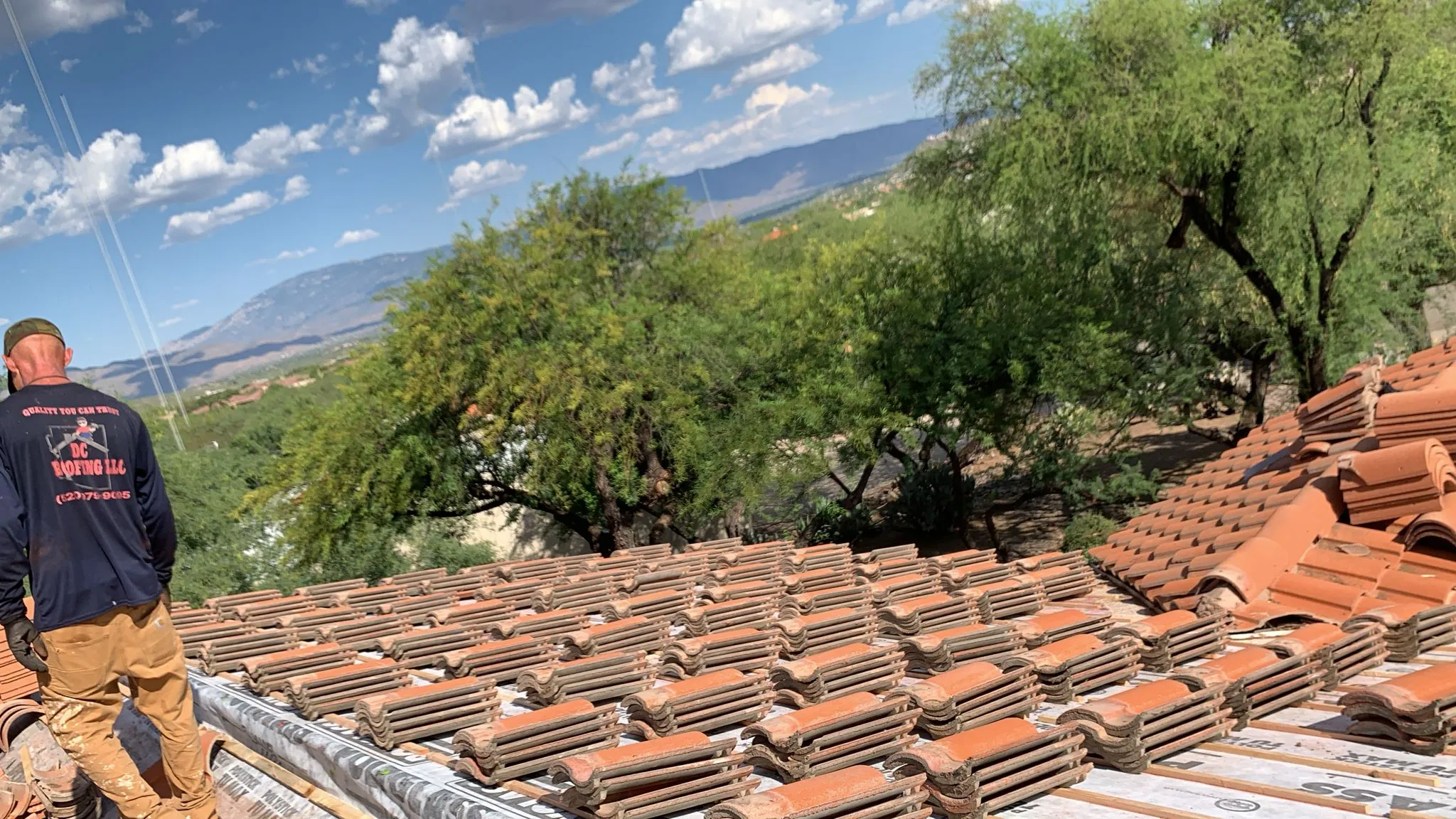
Most roofing problems I see in Tucson didn’t have to happen. A cracked pipe boot that’s been leaking for two monsoon seasons. A clogged scupper that backed up water onto a foam roof until it soaked through. A tile that shifted slightly and was never reset — until the underlayment beneath it rotted out.
These aren’t freak accidents. They’re the predictable result of skipping maintenance on a roof that’s working extremely hard in one of the harshest climates in the country.
Tucson roofs deal with UV exposure that fades and degrades materials faster than almost anywhere else in the U.S., monsoon storms that dump inches of rain in under an hour, summer temperatures that push 110°F on the surface, and winter nights that drop below freezing. That thermal cycling alone — expanding and contracting, day after day — puts stress on every seal, every flashing, and every fastener on your roof.
The good news: a well-maintained roof in Arizona can significantly outlast a neglected one. Here’s what actually matters.
Inspect Twice a Year — Before and After Monsoon
If you do one thing, make it this. A biannual inspection catches small problems before they become expensive ones.
Spring (April–May): Before monsoon season starts is the best time to look at your roof. Check for anything that didn’t survive winter — cracked caulk around vents, lifted flashing, any tiles that shifted during frost cycles. This is when you want to find and fix vulnerabilities, not during a storm.
Fall (October–November): After monsoon ends, assess what the season did. Look for debris that accumulated in valleys and around penetrations, check whether any tiles cracked or moved, and inspect your flat roof membrane or foam coating for ponding damage or new soft spots.
If you’re comfortable on a ladder, you can do a visual check from the roofline. If you have a flat or foam roof, getting up top is reasonable. For tile roofs, be careful — walking on tile requires knowing where to step (on the flat part near the nailing point, never on the raised crown), and one misstep can crack a tile that was perfectly fine.
When in doubt, call a roofer for the inspection. Many companies, including us, offer free inspections. The cost of a professional look is nothing compared to a leak that’s been going for months.
Keep Your Flashings in Good Shape
Flashings are the metal pieces that seal the edges, joints, and penetrations on your roof — around chimneys, vents, skylights, AC curbs, and where the roof meets a wall. They’re usually aluminum or galvanized steel, and they are one of the most common sources of leaks.
In Tucson’s heat, the caulk and sealant used around flashings degrades faster than it would in a cooler climate. UV exposure dries it out, it cracks, and water finds a path. I’ve seen brand-new-looking flashing with sealant that had turned to powder underneath.
What to check:
- Any visible gaps or lifting at the edges of flashings
- Caulk or sealant that’s cracked, shrinking, or pulling away from the surface
- Rust stains running down from flashing areas
- Interior stains on ceilings directly below roof penetrations
Resealing flashing is one of the most cost-effective maintenance tasks there is. Catching it before a monsoon saves you from a ceiling full of water after one.
Clear Drains, Scuppers, and Gutters
Tucson is a desert, but monsoon storms are not gentle. We regularly see 2–3 inches of rain fall in a single hour during peak monsoon season. If your roof’s drainage is blocked, that water has nowhere to go — and it will find somewhere to go.
For flat and foam roofs, your scuppers (the openings through the parapet wall that let water drain off the edge) need to be clear before monsoon. Debris, bird nests, and dried leaves can block them completely. When a scupper is blocked, water ponds on the roof. Extended ponding degrades foam coatings, stresses membrane seams, and adds significant weight load to your structure.
For homes with gutters, clean them in late spring before the first storms. A clogged gutter causes water to back up along the fascia, which can wick under the drip edge and rot the roof deck edge over time.
Know What Your Roof Type Needs
Maintenance looks different depending on what’s on your roof.
Tile Roofs
Tile itself is extremely durable — clay and concrete tile can last 50 years or more. What doesn’t last that long is the underlayment beneath it. The underlayment is the waterproof membrane between the tile and your roof deck, and in Arizona’s heat, it typically has a lifespan of 15–25 years depending on the product.
For tile roofs, maintenance means:
- Replacing cracked, chipped, or missing tiles promptly (they protect the underlayment)
- Keeping valleys free of debris, which holds moisture and accelerates underlayment wear
- Checking pipe boots (the rubber boots around plumbing vents) every few years — they tend to crack before anything else does
- Not power washing the roof, which can drive water under the tiles and damage the underlayment
Flat and Foam Roofs
Spray polyurethane foam (SPF) roofs are common in Tucson and work extremely well here — but they require a recoat of elastomeric coating every 5–10 years to maintain their waterproofing and UV protection. When the coating wears thin, the foam beneath it becomes vulnerable to UV degradation and will begin to bubble and erode.
Modified bitumen and TPO membrane flat roofs need regular inspection of their seams, field, and edges. Heat cycling causes membranes to move, and seams that weren’t sealed perfectly will eventually open.
For any flat roof: address ponding areas. If water consistently pools in one spot after rain and doesn’t drain within 24–48 hours, that area needs attention.
Shingle Roofs
Asphalt shingles are less common in Tucson than tile, but they’re found on plenty of homes, particularly those built in the 1980s and 90s. In this climate, shingles degrade faster than the manufacturer’s rated lifespan. The intense UV breaks down the asphalt binder, shingles lose granules, and they become brittle.
Check for cupping, curling at the edges, or bare patches where granules have worn away. If you’re seeing significant granule loss in your gutters, your shingles are nearing end of life.
What You Can Handle Yourself
A lot of basic maintenance is genuinely DIY-friendly:
- Visual inspections from the ground or a ladder — binoculars help for a closer look at the field without getting on the roof
- Clearing debris from valleys, scuppers, and gutters
- Recaulking around small penetrations — with a compatible sealant like Geocel or NP1
- Replacing a broken tile — if you have spare tiles and know where to step
What you should call a professional for:
- Anything involving the underlayment or membrane
- Flashing replacement or major resealing
- Foam roof recoating
- Any repair near a skylight, chimney, or HVAC curb
- Any leak you can’t immediately trace to a single obvious source
How Often Should You Schedule Professional Maintenance?
My honest recommendation: every 2–3 years for a professional inspection and tune-up, in addition to your own spring and fall walkabouts. For foam roofs, every time you’re approaching a recoat window. For older tile roofs (20+ years), annually isn’t overkill.
The math is straightforward. A professional maintenance visit runs a few hundred dollars. A roof deck replacement because a slow leak went undetected for two years can run into the tens of thousands. Tucson’s climate is hard enough on roofing materials that you can’t afford to assume everything is fine.
What a Professional Maintenance Visit Covers
When I talk about professional maintenance, I’m not describing a five-minute walk-around. A thorough maintenance visit on a Tucson roof covers a specific checklist that most homeowners can’t safely or effectively check themselves.
What we look at:
- Full surface inspection — walking the roof systematically to check every tile field, ridge line, hip cap, and valley for shifted, cracked, or missing material
- All penetrations — every pipe boot, vent flashing, HVAC curb, and skylight inspected and probed for seal integrity
- Flashing condition — all wall, chimney, and edge flashings checked for lifted edges, cracked sealant, and corrosion
- Underlayment sample check — lifting tiles in representative areas to assess membrane condition and catch early degradation before it becomes a leak
- Drainage — verifying scuppers, gutters, and downspouts are clear and functioning
- Minor repairs included — most maintenance visits include resealing small gaps, resetting loose tiles, and clearing debris while we’re up there
What comes out of it: a written condition report and, if anything significant is found, a clear explanation of what needs attention and what it would cost to fix. No guessing, no vague “your roof needs some work.”
A Tucson Roof Maintenance Calendar
Here’s how maintenance fits into the Arizona year:
March–April: Schedule your pre-monsoon inspection. This is the highest-value window — enough time to identify and fix anything that could be a problem before the first storm. Also a good time to clear winter debris from valleys and check flashing sealant after winter frost cycles.
May–June: Act on anything found during the spring inspection. June is the last comfortable month for roofing work before summer heat becomes extreme. Avoid scheduling non-urgent work in July and August — surface temperatures reach 150°F+ and it’s hard on both materials and crew.
October–November: Post-monsoon assessment. Check what the season did — shifted tiles, debris accumulation in valleys, any new staining on interior ceilings. Also the ideal window for foam roof recoating before winter.
December–February: Lower priority unless something specific came up in the fall. Winter in Tucson is mild, but frost cycles can work flashing sealant loose over time — worth a visual check if the roof is older.
Frequently Asked Questions
How often should I have my Tucson roof professionally inspected?
Every two to three years is a reasonable baseline for most roofs in good condition. Once a year is appropriate for roofs over 20 years old, roofs with a history of repairs, or foam roofs approaching a recoat window. In between professional visits, a quick visual check from the ground in spring and fall catches the obvious issues — displaced tiles, blocked scuppers, debris in valleys.
What does a professional roof maintenance visit cost in Tucson?
A standard inspection and tune-up from a licensed roofing contractor typically runs $150 to $350 for a residential roof, depending on size and complexity. Some contractors offer free inspections. If minor repairs are included during the visit — resealing a boot, resetting a tile — expect a modest additional charge. A maintenance visit that catches a failing pipe boot early is far cheaper than a service call after the resulting leak has damaged your ceiling.
What is the best time of year to schedule roof maintenance in Arizona?
Spring, specifically March through April, is the optimal window. You have time to address anything found before monsoon season starts in early July. The weather is comfortable for roofing work, and the roof has had time to show the effects of winter. October and November are the second-best window — post-monsoon assessment with enough good weather left to make any repairs before winter.
How do I know if my roof needs maintenance or an actual repair?
Maintenance is preventive — scheduled work done before problems occur. Repair is reactive — fixing something that has already failed. If you have an active leak, missing tiles, or visible damage, that’s a repair situation. If the roof appears intact and has no active issues but hasn’t been looked at in a few years, that’s a maintenance situation. The two often overlap: a maintenance visit may find items that need repair. That’s the point.
Can regular maintenance actually extend my roof’s lifespan?
Yes, meaningfully. The primary lifespan-limiting factor on a tile roof is underlayment degradation, and the primary driver of accelerated degradation is moisture intrusion — water getting under the tiles through cracked boots, failed flashing, or debris accumulation. Catching and fixing these entry points before they let water in preserves the underlayment. A roof with consistent maintenance history routinely outlasts a neglected roof of the same age by 5 to 10 years.
If you haven’t had your roof looked at in a few years, now is a good time — especially heading into another monsoon season. DC Roofing of Arizona offers free estimates and inspections throughout Tucson and Southern Arizona. Give us a call or schedule online and we’ll take a look.