
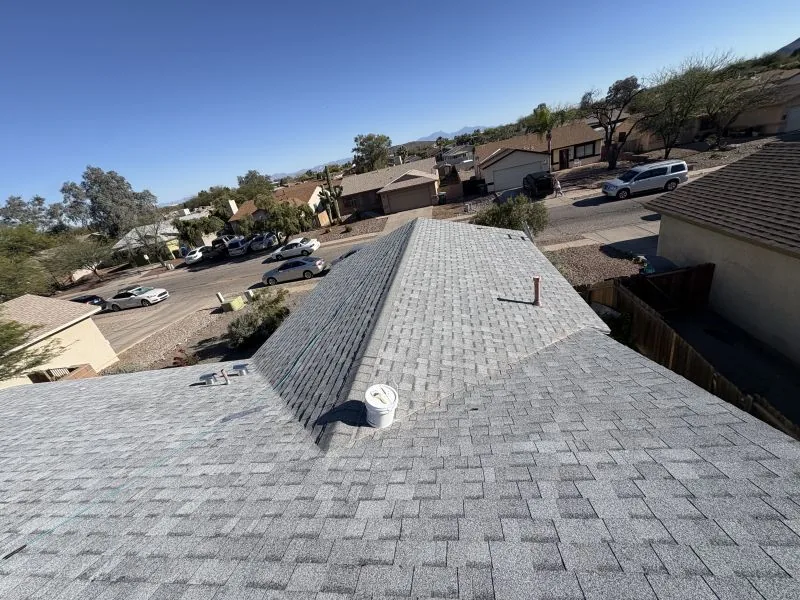
Most homeowners get their first roof replacement quote and immediately wonder why the number looks so different from what they expected - or why their neighbor’s job cost less. The answer almost never comes down to square footage alone. David Contreras, who’s been roofing in Tucson since 2011, walks every roof himself before writing a number down, because the real cost only becomes clear once you can see the actual roof.
The Real Range for a Roof Replacement
A full roof replacement with DC Roofing of Arizona runs $10,000 to $25,000 or more, with $20,000 landing as a common number for a typical tile job. This is most of what we do - somewhere between 90% and 99% of the jobs we run are full re-roofs rather than repairs, and about 90% of our overall work is tile, since that’s the dominant roof type on Tucson homes. Shingle and flat or coated systems make up the rest.
What Drives the Final Price on a Roof Replacement
Most homeowners we talk to in Tucson have the same question. “Why did my neighbor pay one amount and I’m looking at something totally different?” Roof replacement cost depends on your specific house, not somebody else’s. It happens all the time.
The biggest factor is roof size, measured in squares. One roofing square equals 100 square feet. A 1,500-square-foot ranch home over near Sam Hughes isn’t the same job as a 3,000-square-foot two-story. More surface area means more material, more labor, more time on the roof.
But square footage alone doesn’t tell the whole story. Here’s what else moves the number:
- Roof pitch and access. Steep roofs need extra safety equipment and slow the crew down. Flat or low-slope roofs common on older Tucson homes have their own material requirements.
- Layers to remove. If your existing roof has two or three layers stacked on top of each other, tear-off takes longer and creates more disposal weight.
- Decking condition. We don’t know what’s under your tiles or shingles until we pull them up. Rotted or damaged decking has to be replaced before anything new goes on.
- Penetrations and features. Evaporative coolers, vents, skylights, chimneys. Every hole in your roof needs proper flashing. More penetrations means more detail work, since we seal each one with a 3-course mastic method rather than a quick bead of cement.
- Material type. Concrete tile, clay tile, shingles, foam, TPO. Each one carries different material and labor demands.
Material costs themselves move too - we’ve watched prices climb multiple times a year, usually in January, again mid-year, and around August, running anywhere from 6% to 20% depending on the item. That’s part of why we quote your job at the time we look at it rather than off a price list from six months ago.
Tucson’s climate adds a layer most people don’t think about. Intense UV breaks down underlayment faster than in cooler regions. Thermal cycling stresses every seam and seal on your roof year-round, not just in summer. So what’s underneath matters as much as what’s on top.
Wondering if a repair might handle it instead? Sometimes it can. David walks every roof himself and gives you a straight answer. We’re not going to push a full replacement if a targeted roof repair solves the problem. That’s how we operate, licensed under ROC #328733 and backed by over 800 completed projects across Tucson.
What’s Included and What’s Not
A full re-roof with us covers four things: tear-off and disposal of the old roof, a complete manufacturer-warrantied system installed as one package rather than pieced together, our 3-course mastic sealing at every pipe and penetration, and daily jobsite cleanup. We’re registered with Polyglass, which backs a 30-year manufacturer warranty on underlayment, and GAF certified, which supports up to a 50-year manufacturer warranty on shingle systems when the full install package goes in. On top of that, tile roofs carry our 15-year labor warranty, and shingle installs carry a 10-year labor warranty.
What’s not included: interior repairs from a prior leak, like drywall, ceiling, or paint work - that’s a separate scope from the roof itself. Solar panel removal and reinstallation isn’t part of our job either. We coordinate the timing with your solar company, but they handle the panels themselves. Older solar installs, especially ones done before around 2020 by bigger out-of-state chains, tend to take more labor to work around than newer, better-sealed local installs, since the mounts weren’t always done with a future re-roof in mind.
Flat Roofs vs. Pitched Roofs: A Cost Comparison That Actually Fits Tucson Homes
Your roof shape changes everything about your roof replacement cost. We see it constantly across Tucson. A homeowner near Barrio Viejo with a flat roof and a homeowner in the Catalina Foothills with a steep tile pitch are looking at two very different projects.
Flat and low-slope roofs are common on older homes, mid-century builds, and commercial properties here. They’re simpler to access, which can lower labor time. But they come with their own challenges. Water doesn’t shed off a flat roof the way it rolls down a pitched one. That means the underlayment, drainage, and coating system all have to be right. One weak spot and monsoon season will find it. A full flat-roof system replacement - a tear-off and new roofing system, not a recoat - tends to land around $20,000 depending on the building, roughly the same territory as a tile job once you account for size. Recoating an existing flat roof on its 4-6 year maintenance cycle is a separate, far smaller job.
Pitched roofs, especially the clay and concrete tile systems you see all over Tucson, involve more material and more labor. Crew members work on steeper angles. Tile is heavy. Removing old tile, inspecting the deck, and setting new underlayment takes longer than stripping a flat roof. So the labor portion of your estimate runs higher.
Here’s what matters more than the shape itself, though:
- Flat roofs often need more frequent roof coating and maintenance to stay sealed against UV damage
- Pitched tile roofs hold up longer in direct sun but cost more upfront to replace
- Evaporative cooler penetrations on flat roofs are one of the most common leak sources we deal with
- Accessibility issues on steep pitches can add to labor costs if special equipment is needed
Most of the time, the homeowner who calls us doesn’t know which category their roof falls into. That’s fine. David comes out, looks at the actual structure, and walks you through what your specific roof needs. Not a generic estimate based on square footage alone.
The real takeaway? Don’t assume flat is cheaper or pitched is better. Tucson’s heat and thermal cycling stress both types differently. What drives your cost is the condition underneath, not just the shape on top.
How Monsoon Season Affects Your Replacement Timeline and Scheduling
Tucson’s monsoon season runs roughly June through September. That’s four months where afternoon storms can roll in fast, dump heavy rain, and disappear in an hour. We watch the radar constantly during those months because an open roof and a sudden downpour don’t mix.
Here’s what most homeowners don’t realize. Roof replacement cost isn’t just about materials and labor. Timing plays a real role. If your project lands in the middle of monsoon season, there are extra steps we take to protect your home, and those steps can affect the schedule.
What Changes During Monsoon Months
When we tear off an existing roof, the underlayment and decking are exposed. On a dry January day over in the Catalina Foothills, that’s not a big concern. But in July? We have to plan each day’s work around weather windows. Some of the adjustments look like this:
- We tear off only what we can waterproof the same day
- Tarps and temporary seals go down every afternoon before we leave
- Crew start times shift earlier to beat the afternoon buildup
- Material deliveries get staged differently to keep everything dry
A job that might take three days in October could stretch to five or six in August. Not because anyone’s moving slow. The weather just dictates the pace.
It’s a pattern we see every summer. A homeowner waits until they notice a leak during the first big storm, then calls in a panic. By that point, every roofer in Tucson is booked up. The smart move? Get your roof inspection done in spring. If replacement is the recommendation, schedule it before the storms start.
And if you’re already in monsoon season when the need hits, don’t panic. We’ve done hundreds of replacements during July and August. It just takes careful planning and a crew that knows how to work around Tucson weather. David grew up here. Our team knows the rhythm of these storms. We don’t guess at the forecast. We build the schedule around it.
Bottom line: monsoon season doesn’t stop the work. It just changes how we approach it.
What a Thorough Roof Estimate Should Include
You’d be surprised how many estimates we see that are just a number on a piece of paper. No breakdown. No explanation. Just “roof replacement: $X.” That tells you almost nothing about your roof replacement cost, and it makes it impossible to compare one contractor’s bid to another.
A real estimate should read like a plan for your project. Here’s what we include every time we walk a roof in Tucson:
- A full roof inspection with photos showing current damage, worn areas, and problem spots like cracked tiles or failed flashing around cooler penetrations.
- Material specifications. Not just “new shingles” or “tile.” The actual product, the underlayment type, and whether your decking needs repair or replacement.
- Scope of tear-off. Are we stripping everything down to the deck? Doing a partial overlay? You need to know exactly what’s being removed.
- Sealing method. Ask what a contractor uses at pipe boots and flashing - we use a 3-course mastic method rather than a quick bead of cement, and that detail says a lot about how the rest of the roof gets treated.
- Labor details. How many days, how many crew members, and what the cleanup process looks like.
- Permit and code information. Tucson requires permits for full roof replacements. If a contractor skips that, walk away.
We run into this constantly over in the Catalina Foothills. A homeowner gets three bids, two are vague one-liners, and ours is two pages long. They call back and say, “Yours was the only one I could actually understand.” That’s the point.
And here’s something most people don’t think about. Your estimate should note any structural issues found during the inspection. Sagging decking, damaged fascia, ventilation problems. These things change the scope of work fast. If they’re not mentioned upfront, they become surprise charges later.
David writes every estimate himself after walking the roof in person. Not a sales rep. Not someone reading from a script. The person who’s going to be responsible for the job is the same person explaining what it involves. We’re licensed under ROC #328733, so everything we quote meets code and can be verified.
If an estimate doesn’t answer your questions before you even ask them, it’s not thorough enough.
Hidden Decking Damage and Why It Changes the Final Number
Here’s what catches most homeowners off guard. Your roof can look fine from the street and still have serious problems underneath. We pull back old tile or shingles on jobs across Tucson and find plywood decking that’s soft, dark, or crumbling at the edges. It happens more than people expect.
That’s rot. And you can’t know it’s there until the old roof comes off.
Decking is the flat wood layer your entire roof sits on. Think of it as the foundation. If sections of it have gone bad, we can’t just lay new materials on top. That would be like putting fresh paint on a wall that’s falling apart. The damaged sheets have to come out and get replaced before anything else happens. This adds material and labor to the job, which changes your roof replacement cost in ways no one could predict from the ground.
What Causes Decking Damage in Tucson
Tucson’s climate creates a few specific problems that eat away at decking over time:
- Monsoon rain finding its way through cracked tile or failed flashing, sitting against the wood for months
- Evaporative cooler penetrations that weren’t sealed right, letting moisture drip onto the same spot year after year
- Thermal cycling that loosens fasteners and sealants, creating tiny gaps water exploits during storms
- Older homes in areas like the Sam Hughes neighborhood with original decking that’s simply reached the end of its life
We’ve pulled roofs off homes near Reid Park where the decking around a cooler mount was completely gone. Just soft pulp. The homeowner had no idea. No visible leak inside the house, no water stains on the ceiling. But the wood had been absorbing moisture slowly for years.
So what does this mean for you? Any honest estimate should explain that decking condition is an unknown until tear-off day. A contractor who gives you a locked-in number without mentioning this possibility is either inexperienced or not being straight with you. We always walk homeowners through what could be found and how we handle it if it shows up. No surprises - just a quick conversation on-site before we move forward. David makes that call himself, usually with photos sent right to your phone.
Financing and What Else Affects Your Total
We don’t offer financing. If a payment plan is what makes the project possible for you, that’s worth planning for before you request a quote, since we won’t be able to break the cost into payments on our end. What we do control is keeping the rest of the process free of surprises - every inspection and every written estimate is free within the Tucson metro, with no call-out fee. The only time we charge for a visit is a formal multi-page inspection report, the kind often needed for refinancing a home, which runs $250 to $300.
For jobs outside the immediate Tucson area - Sedona, Phoenix, Sierra Vista, or statewide commercial work - travel and lodging get folded into the quote itself rather than tacked on as a separate line item later.
Frequently Asked Questions
Why does my neighbor’s roof replacement cost so much less than my estimate?
Every roof is priced on its own conditions, not a flat rate. Your neighbor may have a smaller roof, fewer layers to tear off, or better decking underneath. In Tucson, factors like roof pitch, evaporative cooler penetrations, and how much UV damage has hit the underlayment all change the number. Until someone actually pulls up your existing material, nobody knows what’s hiding underneath. That’s why two houses on the same street can have very different final costs.
Does it cost more to replace a roof during Tucson’s monsoon season?
It can take longer, which affects the overall project cost. During monsoon season, we can only tear off what we can waterproof the same day. Tarps go down every afternoon. Crew start times shift earlier to beat the storms. A three-day job in October can stretch to five or six days in August. The smartest move is to schedule your replacement in spring before the storms start. If you wait until a leak shows up mid-monsoon, every roofer in Tucson is already booked.
Is a flat roof cheaper to replace than a pitched tile roof in Tucson?
Not always, even though flat roofs are simpler to access. A full flat-roof system replacement tends to land around $20,000 depending on the building and material tier - similar territory to a tile job once you account for size. That’s a different job than recoating an existing flat roof on its 4-6 year maintenance cycle, which runs a fraction of that cost. Pitched tile roofs cost more upfront because tile is heavy and labor runs longer on steeper angles. What really drives your cost is the condition of the decking underneath, not just the shape on top.
What happens if the decking under my roof is rotted or damaged?
Damaged decking has to be replaced before any new material goes on. We don’t know what’s underneath your tiles or shingles until we pull them up. Rotted boards, soft spots, or water-damaged sections all get swapped out during the tear-off phase. This is one of the most common surprises homeowners run into. It’s not something any honest contractor can predict upfront. A thorough inspection after tear-off tells us exactly how much decking needs attention before the new roof goes down.
How many layers of old roofing material affect the replacement cost?
More layers mean more tear-off time and heavier disposal weight, both of which raise your cost. Some older Tucson homes have two or even three layers stacked on top of each other from previous re-roofs. Removing all of that takes longer than a single-layer strip. It also adds to the haul-away load. Most roofing codes limit how many layers can stay on a structure anyway, so if you’re already at the limit, a full tear-off is required before anything new goes on.
What’s included in the price, and what isn’t?
The price covers full tear-off and disposal of the old roof, a complete manufacturer-warrantied system installed as one package, our 3-course mastic sealing at every pipe and penetration, and daily jobsite cleanup. It does not cover interior repairs from a prior leak, like drywall, ceiling, or paint work. Solar panel removal and reinstallation also isn’t part of our scope - we coordinate the timing with your solar company, but they handle the panels themselves.
Do you offer financing for a roof replacement?
We don’t offer financing at this time. If paying the full range upfront doesn’t fit your situation, that’s worth planning for before you request a quote, since we won’t be able to break the cost into payments on our end.
Do you charge extra for jobs outside Tucson?
No, we don’t add a separate travel fee. For work in places like Sedona, Phoenix, or Sierra Vista, travel and lodging costs get folded into the quote itself, so the number you see upfront is the number you pay, not a base price plus surprise charges later.
Ready to see what your specific roof would run? DC Roofing offers free inspections throughout Tucson and Southern Arizona, and every written estimate walks through exactly what’s driving your number.