
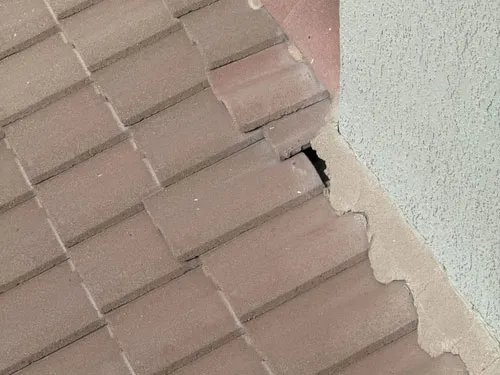
Monsoon season in Tucson is serious weather. When a storm rolls through — the kind that drops two inches of rain in forty-five minutes, with wind gusts that top 60 mph — it’s worth taking a few minutes afterward to check whether your roof came through clean.
The problem is that roof damage isn’t always obvious from the ground, and interior leaks sometimes don’t show up until the next heavy rain. Knowing what to look for right after a storm can help you catch problems before they get worse — and before the next monsoon arrives.
Here’s how to assess your roof after a Tucson monsoon storm.
Start Inside the House
Before you go outside or get anywhere near a ladder, do a quick walk through your interior. Storm damage often shows up inside before it’s visible from outside.
What to look for:
- Fresh water stains on ceilings or walls, especially in upstairs rooms or near exterior walls
- Soft, bubbling, or discolored drywall
- Water dripping from light fixtures or around ceiling fans (this is also an electrical hazard — turn off the circuit if you see this)
- Damp spots on attic insulation if you have attic access
- Any new musty smell in rooms that weren’t damp before
A stain that wasn’t there before the storm is a clear signal. Even if it’s just a small ring, note the location — it will help a roofer narrow down where the entry point is.
Check the Exterior from the Ground
You can learn a lot without getting on the roof. Walk the perimeter of your house and look up.
For tile roofs:
- Look for any tiles that are clearly out of alignment — shifted, lifted, or sitting at an angle different from the surrounding tiles
- Missing tiles leave a visible gap in the pattern
- Look along the ridge line and hip caps; these are the first to move in high wind
- Check the valleys (the low V-shaped channels where two roof planes meet) for debris accumulation or displaced tiles
For flat and foam roofs:
- If you can see the roof surface from a second-floor window, a raised area, or an adjacent structure, look for standing water or debris
- Look for any visible membrane that’s been lifted, torn, or pulled back at edges
- Check that scuppers (drainage outlets through the parapet wall) aren’t visibly blocked by debris
For all roof types:
- Check gutters and downspouts — are they still attached and undamaged?
- Look for granules from asphalt shingles washed down into gutters or pooling at downspout exits
- Check the fascia (the board along the roof edge) for signs it took a hit from debris
- Look for tree branches or other debris on the roof
Check Your Yard and Perimeter
The debris around your home after a storm tells a story about what happened to your roof.
If you find pieces of shingle in your yard, that’s obvious — shingles came off. If you find roofing felt or foam material, same thing. Roof tiles that have slid off will typically land close to the house and are hard to miss.
Also look at neighboring homes if you can. If the storm was severe enough to do visible damage to nearby roofs — missing tiles, damaged flashing — yours may have taken a hit as well.
Get on the Roof (Carefully) or Call Someone
If your ground-level inspection raises any concerns, the next step is a close-up look at the roof surface. For flat roofs, this is generally straightforward. For tile roofs, be careful.
Walking on tile safely: Step on the flat portion of each tile near the nailing point — never on the raised crown where tiles overlap. One wrong step can crack a tile that was undamaged by the storm, creating a problem that didn’t exist before you got up there. If you’re not sure where to step, don’t get up there.
What to look for up close:
- Cracked, broken, or chipped tiles (hairline cracks matter — water finds them)
- Tiles that are no longer fully seated and can be shifted by hand
- Pipe boots (rubber boots around plumbing vents) that have cracked or been pushed off
- Flashing around skylights, chimneys, and HVAC curbs that’s been lifted or pulled away from the surface
- On flat roofs: areas where the membrane has ballooned, separated at seams, or been punctured by debris
- Any debris that’s been driven into or under the roofing material
After a Storm: Watch Out for Storm Chasers
This is worth saying directly: after major monsoon events, you will see roofers going door-to-door in affected neighborhoods offering free inspections and same-day estimates. Some of these are legitimate. Many are not.
Storm chaser contractors — companies that move from disaster to disaster and aren’t based in your area — are a well-documented problem in Arizona after severe weather. They offer low prices, collect deposits, do shoddy work or disappear entirely, and move on before the problems show up.
Before you let anyone on your roof, verify they hold an Arizona ROC license (you can check at the Arizona Registrar of Contractors website). A licensed local contractor has something to lose by doing bad work. An out-of-state crew that showed up this week does not.
When to Call Immediately vs. When It Can Wait
Call the same day if:
- You have active water intrusion into the living space — our emergency roofing service is available for urgent situations
- A tree or large branch came down on the roof
- Significant sections of tile are missing or clearly displaced
- You see torn or lifted membrane on a flat roof
Can schedule within a few days if:
- You spotted a few cracked or slightly shifted tiles with no interior evidence of leaking
- You found minor debris accumulation in valleys or gutters
- You’re seeing granule loss from shingles but no active leak
Don’t wait past the next rain if:
- Anything was damaged — monsoon season typically runs through September, and a roof that took a hit in one storm is more vulnerable in the next one
Documenting Damage for an Insurance Claim
If you suspect your roof took storm damage, documentation matters — both for your own records and for an insurance claim.
Do this as soon as it’s safe:
- Photograph everything before any cleanup or temporary repairs. Photos timestamped the day of the storm carry more weight than photos taken a week later.
- Take wide shots showing overall roof condition and close-ups of specific damage points
- Photograph any interior damage — ceiling stains, wet insulation, damaged drywall — from multiple angles
- Note the date and approximate time of the storm. Weather Underground maintains historical records by zip code if you need to pull data later.
Temporary repairs are allowed and often necessary. Insurance policies typically require you to mitigate further damage — if you have an active leak, put a tarp up or have a contractor do a temporary patch rather than letting the interior continue to be damaged. Keep receipts for any emergency materials or service calls. These costs are generally reimbursable.
Get a written inspection report. Before your adjuster visits, have an independent roofing contractor document the damage in writing. Adjusters are professionals, but they’re employed by the insurance company. Having your own contractor’s assessment in hand gives you something to compare against the adjuster’s findings and strengthens your position if there’s a dispute about scope.
Tucson Monsoon Season: What the Data Shows
Understanding what monsoon actually does helps calibrate how seriously to take post-storm checks.
Tucson’s monsoon season officially runs June 15 through September 30. The peak is typically mid-July through mid-August. During that period:
- Average rainfall is 6–8 inches, representing roughly half of Tucson’s annual average — compressed into about 10 weeks
- Intense convective storms can drop 1–3 inches in under an hour, far exceeding what most drainage systems were designed to handle
- Wind gusts during haboobs and storm outflows regularly reach 50–70 mph, occasionally higher
- The rapid temperature drop as a storm arrives — sometimes 30°F in 20 minutes — creates thermal shock that stresses sealant joints and flashing bonds
The takeaway: Tucson’s monsoon is legitimately severe by national standards. A roof with minor vulnerabilities heading into July will almost certainly reveal them before September.
Frequently Asked Questions
Does homeowner’s insurance cover monsoon roof damage in Tucson?
Generally yes, if the damage was caused by the storm rather than pre-existing wear. Wind damage, hail impact, and water intrusion from a sudden storm event are typically covered under standard homeowner’s policies. Damage attributed to age, lack of maintenance, or gradual deterioration is usually excluded. If a monsoon was involved, document thoroughly and file a claim — let the adjuster make the determination rather than assuming it won’t be covered.
How long do I have to file an insurance claim for storm roof damage?
Most policies require you to report a claim promptly, often within one year of the event. Do not wait. Even if you’re not sure whether the damage is serious enough to claim, report it while the storm is recent and the connection is clear. Late claims are harder to substantiate and adjusters are more skeptical when significant time has passed.
The damage looks minor — is it still worth calling a roofer?
Yes. Minor visible damage often indicates a larger issue, and minor entry points become major leaks over multiple storm events. A single cracked tile or small lifted flashing that lets water in once may not cause obvious interior damage immediately — but over a monsoon season with several storms, cumulative moisture in the deck can cause rot, mold, and insulation damage that costs far more to remediate than the original roof fix would have.
My neighbor’s tree fell on my roof. Who pays for the repair?
In most cases, your own homeowner’s insurance pays for damage to your property regardless of where the tree came from. Your insurer may then pursue the neighbor’s insurer if negligence can be established — for example, if the tree was visibly dead and the neighbor had been notified. The initial claim goes through your own policy. Document the damage immediately and contact your insurer before removing the tree.
How do I tell if a leak is from the storm or was already there?
If interior staining appeared immediately after the storm and was not present before, it is more likely storm-related. If staining was already present or the roof is old with prior leaks, the claim is harder to substantiate. A roofing contractor who can document the condition of surrounding materials — fresh versus weathered damage, new versus old watermarks on the deck — can help distinguish between the two. DC Roofing provides written inspection reports for this purpose.
If you’re not sure whether what you found is serious, that’s what free inspections are for. DC Roofing of Arizona serves Tucson and surrounding areas — give us a call after a storm and we’ll come take a look.