
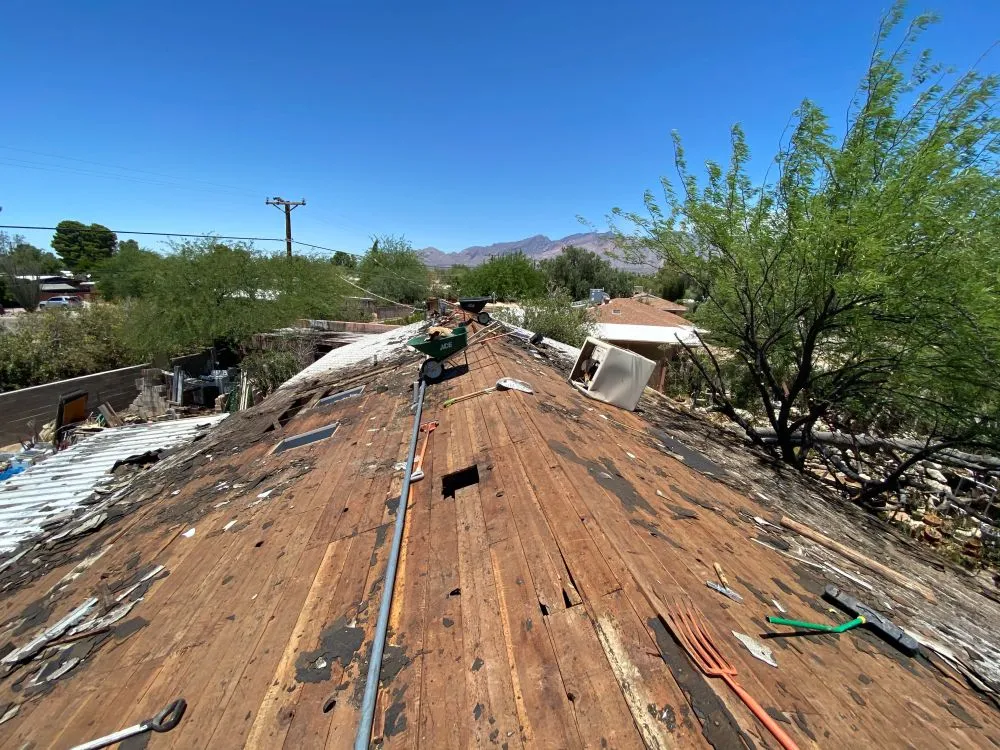
One of the most common questions I get is some version of: “Is it time to replace my roof, or can I keep repairing it?” It’s a fair question, and the honest answer depends on more than just the age of your roof.
In Arizona, the lifespan of a roofing system isn’t just about the material — it’s about how hard that material has been worked. Tucson’s UV index, summer heat, and monsoon cycles accelerate wear in ways that don’t apply in most other parts of the country. A shingle roof rated for 30 years elsewhere might give you 18 in this climate. A foam roof that was never recoated might be done in 10.
Here’s how to think through it by roof type, and how to tell whether you’re looking at a repair or a replacement.
Tile Roofs: It’s Usually the Underlayment, Not the Tile
Clay and concrete tile are among the most durable roofing materials available. A well-installed clay tile roof can last 50 years or more. Concrete tile typically runs 30–50 years. The tile itself rarely fails catastrophically.
What does fail is the underlayment — the waterproof membrane installed beneath the tile, between the tile and the wood deck. That layer is what actually keeps water out of your home. And in Arizona, underlayment has a significantly shorter lifespan than the tile sitting on top of it.
Felt underlayment (the older standard) typically lasts 10–20 years in this climate before it becomes brittle and begins to crack. Synthetic underlayments perform better and can last 20–35 years with proper tile coverage. Either way, you can have perfectly intact tile on your roof while the waterproofing underneath has already failed.
Signs a tile roof may need replacement:
- The roof is 20–25+ years old and has never had the underlayment replaced
- You have multiple leaks appearing in different areas — not just one isolated spot
- During an inspection, lifted tiles reveal underlayment that’s brittle, cracked, or crumbling to the touch
- You’ve been repairing the same roof repeatedly without lasting results
If the underlayment is gone but the tile is in good shape, a full re-underlayment (where tiles are removed, new membrane installed, and tiles reset) is often worth doing. It costs significantly less than a full material replacement and can add another 20–30 years to the roof’s life.
Flat and Foam Roofs: It Depends on Whether It Was Maintained
Spray polyurethane foam (SPF) roofs are one of the best options for flat and low-slope roofs in Arizona when properly maintained. The foam itself can last indefinitely — but only if the protective elastomeric coating on top of it is kept in good shape.
That coating needs to be reapplied every 5–10 years. When it’s neglected, UV radiation begins breaking down the foam itself. It oxidizes, turns yellow, and develops a rough, chalky texture. Eventually, the surface begins to erode, and you start to get pinholes and cracks that allow water in.
A foam roof that has been regularly recoated and maintained can serve a building for 30+ years. A foam roof that was installed and forgotten may need to be torn off and replaced in 10–15 years.
For modified bitumen or TPO membrane flat roofs, lifespan typically runs 15–25 years depending on installation quality, number of layers, and maintenance history. Heat cycling — the daily expansion and contraction that happens when a flat dark roof in Arizona goes from 60°F at night to 170°F surface temp in the afternoon — takes a toll on seams over time.
Signs a flat or foam roof may need replacement:
- Foam surface has widespread oxidation, erosion, or soft spots that have absorbed moisture
- Multiple seam failures on a membrane roof
- The deck beneath the roof (visible during repairs) has moisture damage or rot
- Ponding water that never resolves even after drainage work
Shingle Roofs: Shorter Lifespan in Arizona Than the Label Suggests
Asphalt shingles are rated by manufacturers for 20, 25, 30, or even 50 years under standard conditions. In Tucson, subtract significantly from those numbers.
The intense UV exposure breaks down the asphalt binder that holds the shingle together. The surface granules — which protect the asphalt from UV — shed faster here than in cooler climates. Once granule loss accelerates, the shingles become brittle, curl at the edges, and crack.
A 30-year shingle in Arizona may realistically give you 15–20 years of reliable service. A 20-year shingle might be done in 12–15. If your home has the original shingles from the 1980s or 90s, replacement is almost certainly overdue.
Signs a shingle roof needs replacement:
- Widespread granule loss (you’ll see it accumulating in gutters and at downspout exits)
- Shingles that are curling, cupping, or cracking
- Multiple shingles missing or blown off in areas (not isolated spots)
- Significant age — 15+ years in this climate deserves a close look
Repair vs. Replace: How to Think About It
The decision usually comes down to three factors: age, condition, and repair history.
Age alone isn’t enough. A 25-year-old tile roof with a sound underlayment may have plenty of life left. A 12-year-old foam roof that was never maintained may already be failing.
Condition matters more than age. What does the deck look like? Is the waterproofing membrane intact? Are leaks isolated or appearing in multiple locations? These questions tell you more than the calendar does.
Repair history is a red flag when it’s excessive. If a roof has had five patches in three years and is still leaking, you’re not solving the problem — you’re deferring it at cost. At some point, cumulative repair bills exceed what a replacement would have cost, without ever actually fixing the roof.
A good rule of thumb: if a repair costs more than 30–40% of what a replacement would cost, and the roof is already past the midpoint of its expected lifespan, replacement is worth seriously considering.
Get an Honest Assessment
The challenge with roofing is that most homeowners can’t see enough of what’s happening to make this call themselves. A visual check from the ground doesn’t tell you what the underlayment looks like, whether the deck has moisture damage, or how close the membrane seams are to failing.
What I tell homeowners: get an inspection from a licensed contractor who will give you a straight answer. A good roofer will tell you if repairs will actually solve your problem, or if you’re throwing money at a roof that’s already past its useful life. If a contractor immediately recommends full replacement on a roof that could be repaired — or pushes repairs on a roof that clearly needs to come off — those are both red flags.
How Arizona’s Climate Shortens These Timelines
The lifespans described above assume reasonably consistent maintenance. In practice, Tucson’s climate creates specific failure modes that can shorten them significantly.
UV degradation is the primary driver. Tucson receives more than 300 sunny days per year, with a summer UV index that regularly hits 11 — well above the threshold where organic materials degrade rapidly. Felt underlayment, pipe boot rubber, and flashing sealant all have rated lifespans that assume moderate UV exposure. In Southern Arizona, those ratings are optimistic.
Monsoon stress concentrates damage. Most of Tucson’s annual rainfall arrives in intense bursts between July and September. A roof with minor vulnerabilities going into monsoon season will reveal them during it. The combination of wind-driven rain, rapid temperature changes, and high volume over short periods puts stress on every transition and penetration.
Deferred maintenance compounds quickly. A roof that’s been consistently maintained holds up reasonably close to its rated lifespan. A roof that was installed and largely ignored tends to fail at the underlayment level 5 to 7 years earlier than expected. In this climate, neglect is expensive.
What Roof Replacement Costs in Tucson
Replacement cost varies significantly based on roof type, size, pitch, and materials. Here are realistic ranges for the Tucson market as of 2024:
Tile re-underlayment (removing existing tile, replacing membrane, resetting tile): $6–$8 per square foot installed. For a 2,000 square foot roof, expect roughly $11,000–$19,000. This is the most common replacement scenario for Tucson tile roofs where the tile itself is still in good shape.
Full tile replacement (new tile and underlayment): Add $3–$8 per square foot depending on tile grade and whether the original product can be matched.
Flat roof replacement (TPO or modified bitumen membrane): $5–$10 per square foot depending on existing conditions and number of layers.
Foam roof restoration (removing degraded foam, refoaming, recoating): $6–$12 per square foot depending on how much foam needs to be removed and replaced.
Shingle replacement: $4–$8 per square foot for a standard architectural shingle installation.
Bids significantly below these ranges typically mean something is being skipped — underlayment quality, flashing work, or cleanup. If a number seems too good, ask for a line-item breakdown.
Frequently Asked Questions
How long does a tile roof last in Arizona?
The tile itself — clay or concrete — can last 50 years or more. What limits the functional lifespan of most Arizona tile roofs is the underlayment beneath the tile, which typically lasts 15 to 25 years depending on the product and maintenance history. Most homeowners with a tile roof over 20 years old are approaching or past the point where the underlayment should be evaluated.
What does a full roof replacement cost in Tucson?
It depends on what type of roof you have and what needs to be replaced. For a tile roof where the tile is reusable, a re-underlayment runs roughly $11,000 to $19,000 for a typical 2,000 square foot home. A full shingle replacement on the same size roof might run $8,000 to $16,000. Flat roof replacement ranges from $5 to $10 per square foot. Get at least two estimates from licensed contractors and make sure each one specifies exactly what is and is not included.
Is it worth repairing an old roof or should I just replace it?
A useful benchmark: if a repair costs more than 30 to 40 percent of what a full replacement would cost, and the roof is already past the midpoint of its expected lifespan, replacement is often the better financial decision. Repeated repairs on an aging roof can cost more over 3 to 5 years than a replacement would have, while the underlying problem never actually gets solved.
Will homeowner’s insurance pay for a roof replacement in Arizona?
It depends on the cause. Storm damage from a sudden event — a tree falling, hail impact, wind from a named storm — is typically covered. Age-related wear, gradual deterioration, and maintenance-related failures are almost always excluded. If a monsoon event contributed to your roof’s failure, document everything and file a claim. An inspection report from a licensed contractor helps substantiate the damage.
How long does a roof replacement take?
A full re-underlayment on a typical residential tile roof in Tucson takes 3 to 5 days with a full crew, depending on roof size, pitch, and complexity. A shingle replacement on a straightforward roof can often be completed in 1 to 2 days. Flat roof replacement runs 2 to 4 days. Weather, material availability, and site access can all affect the timeline.
DC Roofing offers free inspections throughout Tucson and Southern Arizona. If you’re not sure where your roof stands, give us a call and we’ll take an honest look.