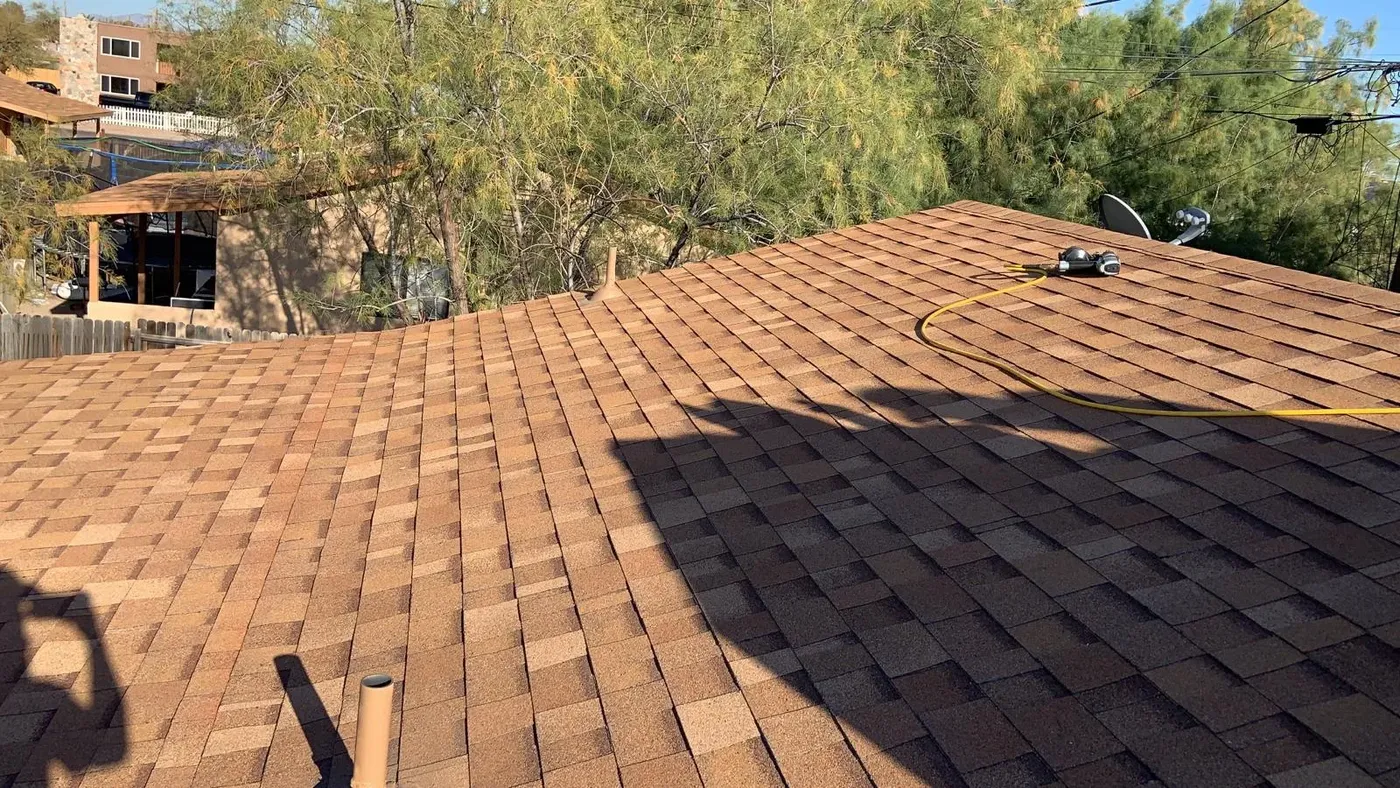
David Contreras, owner of DC Roofing of Arizona, has been roofing in Tucson since 2011, and he's the one who walks every Marana roof we estimate. Most of the re-roofs we do around Tucson are tile, so if your Marana home has asphalt shingles, you're working with a material that ages on a different clock in this desert. This page covers what heat, sun, and monsoon wind do to a shingle roof, how long one realistically lasts, and the warning signs worth acting on. We're licensed, bonded, and insured (ROC #328733), and if a repair is all you need, that's what we'll tell you.
Why Marana's Climate Is Hard on Asphalt Shingles
Shingles are made to flex a little, and sun and heat take that flexibility away. Berkeley Lab's Heat Island Group reports that traditional dark roofs can reach 150°F or higher in the summer sun, and a Marana afternoon in July is exactly that kind of sun. The heat cooks the asphalt binder that holds the granules in place. Over the years the binder dries out, the shingle gets brittle, and granules wash off into your gutters.
Heat isn't working alone, though. Here's what hits a shingle roof out here:
- UV exposure on most days of the year, which breaks down the asphalt
- Big daily temperature swings, so the shingles expand and shrink every single day, loosening sealant strips and nails and opening gaps around flashing
- Monsoon wind from mid-June through September, which catches any shingle edge that isn't sealed down tight
- Driving rain that pushes water sideways under shingle edges, and grit that piles up in valleys
- Dry air and constant sun that dry out sealants and flashing caulk
That daily movement is slow, quiet damage, and it's the one most people never think about. Then monsoon season arrives and finds every weak spot. It's a pattern we see every year: a homeowner notices a few curled shingles in March, puts it off, and calls in July with a stain on the ceiling. The storm usually gets the blame, but the wind didn't cause the problem. It finished what months of sun had started.
Attic ventilation is the other half of the story. A hot, poorly vented attic bakes shingles from underneath while the sun works on them from above. ENERGY STAR explains that airflow in a well-vented attic moves super-heated air out, which protects the shingles and removes moisture. That's why David checks ventilation on every shingle job, and if yours is short on airflow, our roof ventilation service covers the fix.
None of this means asphalt shingles are a bad choice for Marana. The desert doesn't ruin a shingle roof. It shrinks the margin for sloppy work. Proper nailing, sealed edges, good underlayment, and real attic airflow all buy you years.
How Long Asphalt Shingles Last in Marana
Ask ten people how long a shingle roof lasts and you'll get ten answers, and most of them come from places with mild summers and snow. Manufacturers rate shingles for 20, 25, or 30 years under standard conditions, but that's a nominal number, not a guarantee. Around here, a 30-year shingle may realistically give you 15 to 20 years of reliable service, and a 20-year shingle might be done in 12 to 15. Installation quality and ventilation move those numbers more than the label does. Our guide to how long Arizona roofs last covers the other roof types too.
Two roofs installed the same year can age very differently. The south- and west-facing slopes take the most sun and usually wear first, so it's normal for one side of a house to look older than the other. A few conditions shorten shingle life faster than anything else:
- Poor attic ventilation, which traps heat against the underside of the deck
- Dark shingles on unshaded south-facing slopes
- Debris packed into valleys after monsoon storms, holding moisture and grit
- Old or cracked flashing at walls, vents, and evaporative cooler penetrations
- Slow drainage where a low-slope section meets a shingled section
Notice how many of those are fixable. Ventilation, debris, and flashing are maintenance problems, not shingle problems, and they're the reason two identical roofs can age so differently. Age alone doesn't mean replacement, either. A shingle roof at 15 or 18 years old may need flashing work and better airflow instead of a tear-off, and we'd rather tell you that than sell you something your roof doesn't need yet. If it's the original roof from the 1990s, though, replacement is almost certainly overdue.
Warning Signs Your Shingle Roof Needs a Closer Look
Shingles rarely fail all at once. They give you hints first, and almost every early sign can be spotted from the ground or from inside your house. These are the ones worth taking seriously:
- Granules collecting in gutters, at the bottom of downspouts, or along the driveway edge. Granules are the shingle's sunscreen, and once they're gone the asphalt dries out fast
- Curling, cupping, or lifted edges, especially on the sun-facing slopes
- Bald or shiny patches where the granules have worn away
- Cracked or brittle shingles that snap instead of bending
- Missing tabs after a windy night. One or two isn't a crisis, but a whole run of them is
- Exposed or rusting nail heads, and sealant that has dried out and pulled away from flashing
- Daylight showing through the roof deck, or sagging along the roof line
Not every sign means replacement. A few wind-lifted shingles and some tired sealant around a vent is a repair, not a tear-off, and our repairs carry a 2-year labor warranty. A pattern is different: curling across whole slopes, granule loss everywhere, or leaks in more than one spot means the roof is failing as a system. Our roof repair page explains how we handle the smaller jobs.
Want to check on your own? Stay off the roof and do this from the ground and the inside of the house:
- Walk the perimeter and look up at each slope from a distance
- Check the gutters and the ground under the downspouts for granules that look like coarse black sand
- Look at the roof line against the sky. It should be straight, and any dip or wave matters
- Look around every penetration you can see: vents, pipes, skylights, the evaporative cooler
- Check your ceilings for stains, even dry ones, since they mark old leak paths
- Take a few phone photos. Comparing this spring's photos to next spring's shows how fast things are moving
Leave the attic to us. Attics here can get dangerously hot in the afternoon, and one wrong step off the framing can put your foot through the ceiling.
What Shingle Replacement Looks Like With Us
It starts with a free inspection, and it doesn't happen over the phone. We use aerial measurement software to get the actual size and layout of your roof, then David walks it himself to check the decking, flashing, penetrations, ventilation, and the condition of the shingles. You get written findings and a recommendation, with no pressure to sign on the spot.
When a full replacement is the right call, we install GAF-certified shingle systems and Polyglass-registered underlayment because they carry real manufacturer warranties, including up to 50 years on shingles when the full package goes in together. A straightforward shingle replacement can often be finished in 1 to 2 days, though weather, material availability, and site access can move that. David is on every job site, and we don't use subcontracted crews.
We'd rather you know a few things up front: we don't offer financing, and we don't run overnight dispatch. If either is a dealbreaker, better to hear it before we measure your roof. The materials, process, and pricing questions are covered on our asphalt shingle roofing service page, and our roof replacement cost breakdown explains what drives the price.
FAQ: Asphalt Shingle Roofing in Marana
How long do asphalt shingles last in Marana?
Manufacturers rate shingles for 20, 25, or 30 years, but that's a nominal number, not a guarantee. In this climate, a 30-year shingle may realistically give you 15 to 20 years of reliable service, and a 20-year shingle might be done in 12 to 15. Installation quality and attic ventilation affect those numbers more than the label does. A free inspection tells you where your roof actually falls.
Why are there granules in my gutters, and is that a problem?
Granules are the shingle's sun protection, and they wash off slowly over time. Steady buildup that looks like coarse black sand at your downspouts, or bald and shiny patches on the sun-facing slopes, means the surface layer is thinning and the asphalt underneath is drying out faster. That's a good time to have the roof looked at before the next monsoon.
What does monsoon wind do to a shingle roof?
Monsoon gusts catch any shingle edge that isn't sealed down tight, and months of heat can weaken the seal strips before the storm ever arrives. One or two missing tabs is usually a repair. A whole run of lifted or missing shingles means the seals have failed across that section. Proper nailing and sealed edges at installation are what keep a shingle roof in place through June to September.
Can you repair just a few shingles, or do I need a full replacement?
A few wind-lifted shingles or some dried-out sealant around a vent is a repair, and our repairs carry a 2-year labor warranty. Curling across whole slopes, granule loss everywhere, or leaks in more than one spot points to a roof that's failing as a system. We'll tell you which one you have after walking the roof.
How long does a shingle roof replacement take?
A straightforward shingle replacement can often be finished in 1 to 2 days. Weather, material availability, and site access can all affect the timeline, and we'll give you a schedule with your estimate.
Do I need a permit to replace a shingle roof in Marana?
Marana is an incorporated town, so permits go through the Town of Marana. The Town's permit guidance says replacing roofing material like for like does not require a permit, and neither does replacing underlayment only. Repairs to roof sheathing or structural members require a permit, and so does changing to tile from another roofing material. Requirements can change, so check with Town of Marana Development Services before work starts, and check with your HOA if you have one.
Can I check my shingle roof myself?
You can check a lot from the ground. Walk the perimeter, look for curling or bald patches, check the gutters and downspouts for granules, look at every penetration, and check your ceilings for stains. Stay off the roof, and leave the attic to us, since attics here can get dangerously hot in the afternoon. Take photos so you can compare them next spring.
Is DC Roofing of Arizona insured to work in Marana?
Yes. We're licensed (ROC #328733), bonded, and insured in Arizona, and we carry liability insurance and workers' compensation coverage on every job.